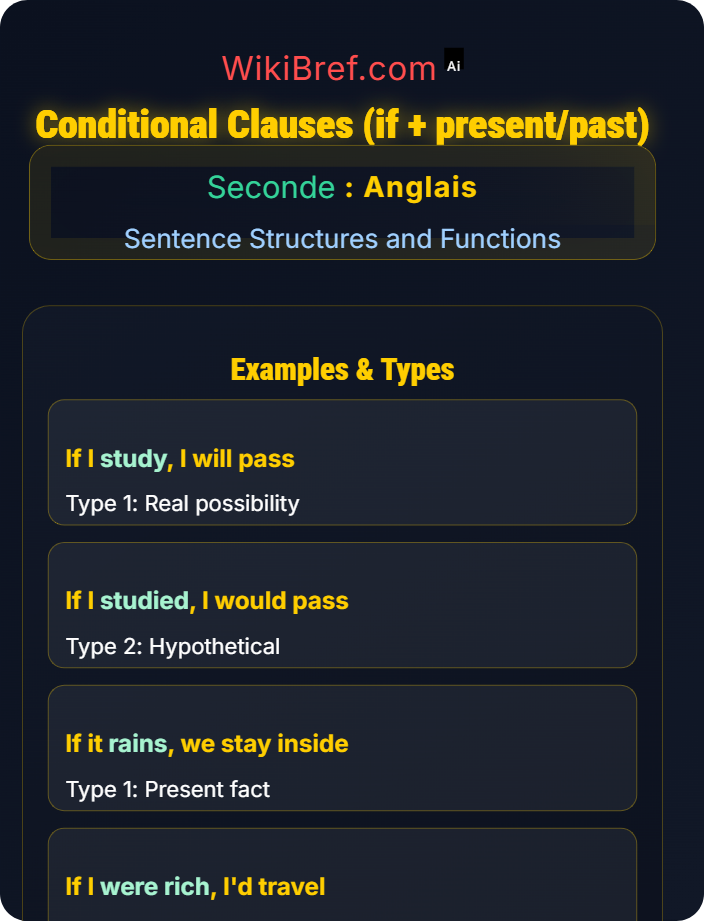
| Type | Structure | Exemple |
|---|---|---|
| First Conditional | If + present simple, will + base verb | If it rains, I will stay home |
| Second Conditional | If + past simple, would + base verb | If I were rich, I would travel |
| Third Conditional | If + past perfect, would have + past participle | If I had studied, I would have passed |
| Mixed Conditional | Combinaison de types | If I had studied, I would be successful |
First Conditional : Pour des situations réelles possibles dans le futur.
"If it ___ sunny" → Situation possible dans le futur → First Conditional
If + present simple, will + base verb
"If it is sunny" → Present simple (is)
"we will go to the beach" → Will + base verb (go)
"If it is sunny, we will go to the beach"
If it is sunny, we will go to the beach
• First Conditional : If + present simple, will + base verb
• Probabilité : Situation réelle possible
• Temps futur : Expression d'une conséquence possible
Second Conditional : Pour des situations irréelles dans le présent.
"If I ___ taller" → Situation irréelle (je ne suis pas plus grand) → Second Conditional
If + past simple, would + base verb
"If I were taller" → Past simple (were pour tout le monde dans le subjonctif)
"I would play basketball" → Would + base verb (play)
"If I were taller, I would play basketball"
If I were taller, I would play basketball
• Second Conditional : If + past simple, would + base verb
• Iréalité : Situation contraire à la réalité
• "Were" : Pour toutes les personnes dans le subjonctif
Third Conditional : Pour des situations impossibles dans le passé.
"If she ___ harder" → Parler d'une situation passée → Third Conditional
If + past perfect, would have + past participle
"If she had studied harder" → Past perfect (had + past participle)
"she would have passed the exam" → Would have + past participle (passed)
"If she had studied harder, she would have passed the exam"
If she had studied harder, she would have passed the exam
• Third Conditional : If + past perfect, would have + past participle
• Impossibilité : Situation passée impossible à changer
• Réflexion : Exprime des regrets ou des hypothèses sur le passé
Transformation : Combiner deux phrases simples en une conditionnelle.
"It rains" et "I stay home" → Lien de cause à effet
Situation possible dans le futur → First Conditional
Condition: "It rains", Résultat: "I stay home"
If + present simple, will + base verb
"If it rains, I will stay home"
If it rains, I will stay home
• Combinaison : Relie cause et effet
• First Conditional : Pour situations probables
• Clarté : Rend la relation logique plus explicite
Transformation : Combiner phrases en conditionnel irréaliste.
"I'm not rich" et "I can't buy a car" → Situation actuelle irréelle
Situation irréelle dans le présent → Second Conditional
Condition: "I were rich", Résultat: "I could buy a car"
If + past simple, would + base verb
"If I were rich, I would buy a car"
If I were rich, I would buy a car
• Second Conditional : Pour situations irréalistes
• "Were" : Pour toutes les personnes
• Hypothétique : Expression d'un souhait ou d'une impossibilité
Transformation : Combiner phrases en conditionnel du passé.
"She didn't study" et "She failed" → Cause et effet passés
Situation passée impossible à changer → Third Conditional
Condition: "She had studied", Résultat: "She would have passed"
If + past perfect, would have + past participle
"If she had studied, she would have passed"
If she had studied, she would have passed
• Third Conditional : Pour situations passées impossibles
• Regret : Exprime ce qui aurait pu arriver
• Past Perfect : Had + past participle dans la clause if
Mixed Conditional : Combinaison de différents types de conditionnels.
"If I ___ studied, I ___ successful now" → Passé + présent
Passé (had studied) + Présent (would be) → Third/Second mixte
"If I had studied" → Third Conditional (past perfect)
"I would be successful now" → Second Conditional (would + base verb)
"If I had studied, I would be successful now"
If I had studied, I would be successful now
• Mixed Conditional : Combinaison de temps différents
• Cause/Passe, Effet/Présent : Had + past participle, would + base verb
• Complexité : Exprime des relations causales complexes
Erreurs fréquentes : Confusion entre les structures conditionnelles.
"If I will see him, I will tell him" → "will" dans la clause if
First Conditional: If + present simple, will + base verb
"If I see him" → Present simple (see)
"I will tell him" → Correct (will + base verb)
"If I see him, I will tell him"
If I see him, I will tell him
• Never "will" in if-clause : Jamais "will" dans la clause if
• Present Simple : Pour exprimer des conditions futures probables
• Erreur courante : Traduction directe de "si je verrai"
Inversion : Omettre "if" et inverser le sujet et l'auxiliaire.
"If I had known, I would have helped" → Third Conditional
"had known" → Auxiliaire "had"
"Had I known" → Had + subject + past participle
"I would have helped" → Reste inchangée
"Had I known, I would have helped"
Had I known, I would have helped
• Inversion : Had/Were/Should + subject
• Formalité : Plus formel que la structure normale
• Third Conditional : Only with "had" inversion
Multiple conditionnels : Plusieurs clauses conditionnelles dans une phrase.
"I don't have money" et "I can't buy a ticket" → Deux situations liées
"If I had money" → Condition hypothétique
Situation irréelle dans le présent → Second Conditional
"If I had money" → Past simple (had)
"I could buy a ticket" → Would/could + base verb
If I had money, I could buy a ticket
• Complexité : Plusieurs relations conditionnelles
• Second Conditional : Pour exprimer des impossibilités
• Modalités : Could, might, would expriment la possibilité