Passive conversion: Changing active sentences to emphasize the action/receiver rather than the performer.
Identify subject, verb, and object; make object the new subject; use "be" + past participle
Active: "Researchers conducted the experiment"
Subject: Researchers
Verb: conducted
Object: the experiment
"The experiment" becomes the new subject
Match tense: "conducted" (past) → "was"
"conduct" → "conducted"
Add "by researchers" if needed for clarity
"The experiment was conducted by researchers" or "The experiment was conducted"
• Grammar Rule: Subject + be + past participle + (by object)
• Academic Purpose: Focus on process/results rather than performers
• Tense Consistency: Maintain original tense in passive form
Passive identification: Recognizing "be" + past participle pattern in academic texts.
Watch for: is, are, was, were, has been, have been, had been, will be, etc.
Regular: verb + -ed (worked, studied)
Irregular: done, seen, taken, etc.
Example: "The results were analyzed by the team"
"were" (be verb) + "analyzed" (past participle)
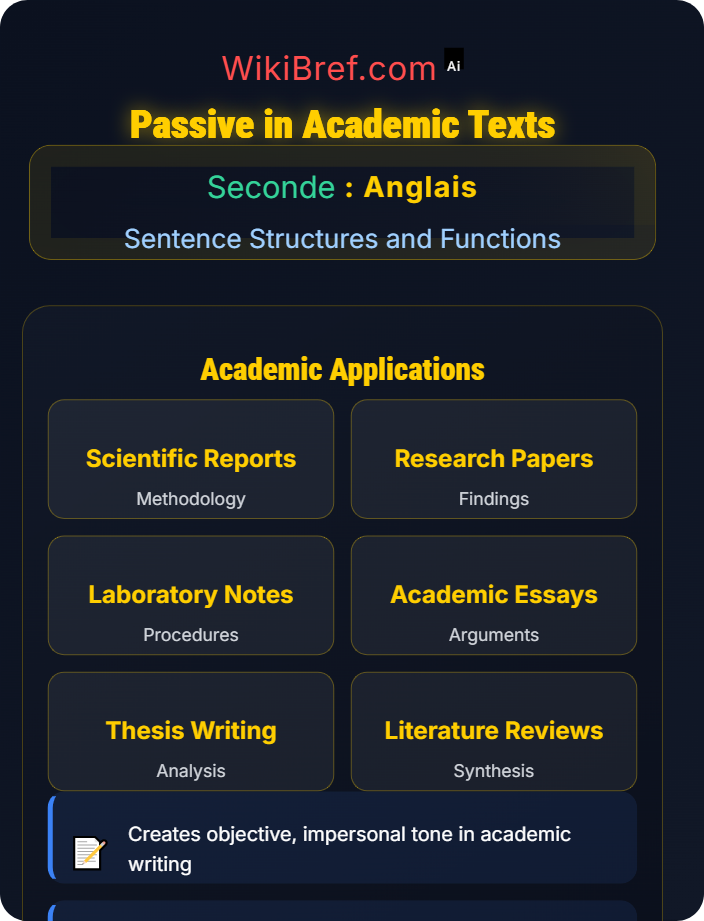
Passive is common in research papers, reports, and scientific writing
Passive constructions typically follow: "be + past participle" and are frequent in academic texts to maintain objectivity.
• Pattern Recognition: "be + past participle" indicates passive voice
• Context Clue: Academic texts frequently use passive for objectivity
• Form Identification: Distinguish from linking verbs (is/are + adjective)
Academic objectivity: Using passive voice to remove personal bias and emphasize facts/processes.
Active: "We observed significant changes"
Contains first person perspective
Focus on what was observed, not who observed it
"Significant changes were observed"
Result sounds more formal and objective
"Significant changes were observed" achieves academic objectivity by removing the personal perspective while maintaining the meaning.
• Objectivity Principle: Remove subjective perspectives in academic writing
• Focus Shift: Emphasize results/processes over researchers
• Academic Convention: Standard practice in scientific literature
Scientific reporting: Systematic documentation of research with standardized passive usage.
Common passive: "Samples were collected", "Data was analyzed", "Tests were performed"
Passive emphasis: "A significant correlation was found", "Results were compared"
Objective statements: "These findings are consistent with previous studies"
Standard format: "It has been suggested that...", "Previous research has shown..."
Scientific reports consistently use passive voice in methods and results sections to maintain objectivity and focus on procedures rather than researchers.
• Section-Specific Usage: Different parts of papers use passive differently
• Standard Format: Established conventions in academic writing
• Professional Expectations: Required for publication in academic journals
Active vs passive: Contrasting sentence structures based on emphasis and purpose.
Subject performs action: "Scientists discovered new evidence"
Clear agent performing action
Subject receives action: "New evidence was discovered"
Focus on what happened to the object
Passive preferred when: agent is unknown, unimportant, or obvious
Active: clearer, more direct
Passive: more objective, formal
Active voice is clearer but passive voice is preferred in academic writing for its objectivity and formal tone, especially when the performer is less important than the action.
• Purpose-Based Choice: Select voice based on intended emphasis
• Academic Standards: Passive expected in formal research contexts
• Clarity Balance: Avoid excessive passive that obscures meaning
Active conversion: Changing passive sentences to emphasize the doer of the action.
Passive: "The experiment was conducted"
"was" (be verb) + "conducted" (past participle)
If present: "The experiment was conducted by researchers"
Agent: researchers
"Researchers" becomes the new subject
"was conducted" → "conducted"
"experiment" becomes the direct object
"Researchers conducted the experiment" (active) from "The experiment was conducted by researchers" (passive)
• Reversal Pattern: Subject ↔ Object when converting between voices
• Agent Recovery: Use "by" phrase to identify the actor
• Verb Transformation: Remove "be" and return to simple form
Experimental writing: Documentation of procedures and results using objective language.
Passive: "Equipment was sterilized", "Solutions were prepared"
Focus on what was done to materials
Passive: "Samples were incubated for 24 hours", "Measurements were taken"
Emphasis on process, not personnel
Passive: "Results were recorded", "Data was analyzed"
Objective presentation of methodology
Passive: "Procedures were verified", "Results were replicated"
Ensures reproducibility focus
Experimental descriptions use passive voice to maintain objectivity, standardize procedures, and emphasize reproducible methods rather than individual researchers.
• Methodology Standard: Consistent procedure documentation
• Reproducibility Focus: Other scientists should replicate procedures
• Objectivity Requirement: Remove personal bias from scientific reporting
Methodology: Detailed explanation of research procedures using standardized passive constructions.
Passive: "Participants were recruited", "Subjects were assigned"
Focus on selection criteria, not recruiters
Passive: "Questionnaires were designed", "Tools were validated"
Emphasis on validation process
Passive: "Measurements were collected", "Information was gathered"
Objective description of process
Passive: "Statistical analyses were performed", "Data were processed"
Focus on analytical methods
Methodological sections use passive voice to provide standardized, objective descriptions of procedures that can be replicated by other researchers.
• Standardization: Consistent methodology presentation across studies
• Replicability: Other researchers must be able to follow procedures
• Impersonal Tone: Remove researcher bias from method descriptions
Contextual evaluation: Assessing when passive voice is most effective in academic writing.
Effective passive: "A correlation was found between variables"
Focus on discovery, not discoverer
Effective passive: "This phenomenon was first documented in 1995"
When the agent is unknown or unimportant
Effective passive: "Samples were processed according to protocol"
Emphasizes procedure, not performer
Problematic passive: "Mistakes were made"
Creates ambiguity about responsibility
Passive voice is most effective when the agent is unknown, unimportant, or obvious; when emphasizing results over actors; and when describing standard procedures.
• Agent Importance: Use passive when agent is irrelevant to meaning
• Result Emphasis: Prioritize outcomes over performers in academic contexts
• Clarity Test: Avoid passive if it obscures meaning or creates ambiguity
Academic mastery: Comprehensive understanding and skillful application of passive voice in scholarly writing.
Master: "be + past participle" formula and tense variations
Present: is/are + past participle
Past: was/were + past participle
Perfect: has/have/had been + past participle
Know when to use passive: research reports, methods sections, objective descriptions
Know when to avoid: when agent is important, when clarity is compromised
Seamlessly incorporate passive into essays, reports, and research papers
Balance with active voice for optimal clarity
Evaluate effectiveness: Does passive enhance objectivity without sacrificing clarity?
Revise as needed to maintain academic standards
Practice regularly with academic texts
Seek feedback on usage
Refine application based on context
Mastery of passive voice in academic writing requires structural knowledge, contextual awareness, practical application, and continuous refinement to achieve professional-level academic communication.
• Comprehensive Mastery: Combine grammatical knowledge with pragmatic application
• Academic Standards: Meet expectations of scholarly communication
• Continuous Development: Regular practice and refinement improves proficiency