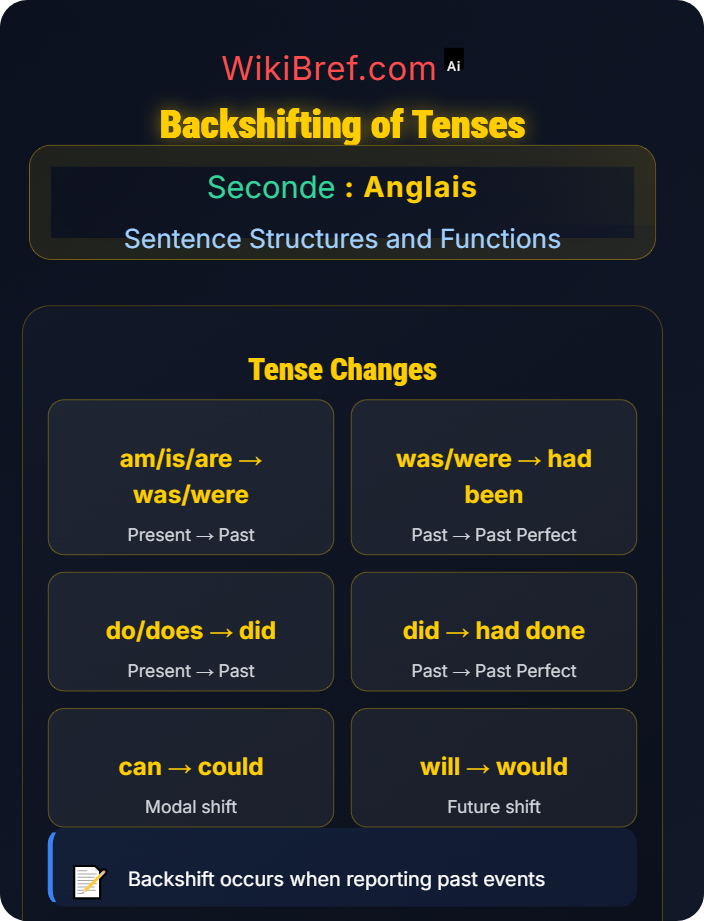
Present to past backshifting: When the reporting verb is in past tense, present tense statements become past tense in reported speech.
Identify reporting verb tense, then shift direct speech one step back in time
Direct: "He says, 'I am happy'"
Reporting verb: "says" (present)
Result: "He says he is happy" (no backshift needed)
Direct: "He said, 'I am happy'"
Reporting verb: "said" (past)
Present "am" → Past "was"
"I am happy" → "he was happy"
"He said he was happy"
Direct: "He said, 'I am happy'" → Reported: "He said he was happy"
• Backshift Rule: Present tense shifts to past tense when reporting verb is past
• Time Reference: Backshift reflects the time when the statement was made
• Reporting Verb: Determines whether backshift occurs
Past to past perfect backshifting: When the reporting verb is in past tense, past tense statements become past perfect in reported speech.
Direct: "She said, 'I went to the store'"
"went" is past tense
"said" is past tense, so backshift occurs
Past tense "went" → Past perfect "had gone"
"She said she had gone to the store"
Direct: "She said, 'I went to the store'" → Reported: "She said she had gone to the store"
• Sequential Backshift: Past tense → Past perfect
• Temporal Relationship: Maintains chronological order of events
• Time Sequence: Past perfect shows action completed before another past action
Present perfect backshifting: When the reporting verb is past tense, present perfect becomes past perfect in reported speech.
Direct: "He said, 'I have finished my homework'"
"have finished" is present perfect
"said" is past tense, so backshift occurs
Present perfect "have finished" → Past perfect "had finished"
"He said he had finished his homework"
Direct: "He said, 'I have finished my homework'" → Reported: "He said he had finished his homework"
• Perfect Backshift: Present perfect → Past perfect
• Completion Reference: Maintains sense of completed action
• Relative Time: Shows action completed before moment of speaking
Past perfect preservation: When the reporting verb is past tense, past perfect remains past perfect in reported speech.
Direct: "She said, 'I had already eaten dinner'"
"had eaten" is past perfect
"said" is past tense, but past perfect doesn't change
Past perfect "had eaten" stays as "had eaten"
"She said she had already eaten dinner"
Direct: "She said, 'I had already eaten dinner'" → Reported: "She said she had already eaten dinner"
• Perfect Preservation: Past perfect remains unchanged in backshifting
• Temporal Logic: Past perfect is already "back-shifted" from present perfect
• Sequence Maintenance: Keeps the order of past events intact
Modal backshifting: Modal verbs change to their past equivalents when reporting verb is in past tense.
can → could
will → would
may → might
shall → should
must → had to (or still must for obligation)
Direct: "He said, 'I can swim'"
"can" → "could"
Direct: "She said, 'I will come tomorrow'"
"will" → "would"
"He said he could swim"
"She said she would come tomorrow"
Modal verbs backshift as follows: can→could, will→would, may→might, shall→should, must→had to
• Modal Transformation: Each modal has specific past equivalent
• Ability Reference: Can→could indicates past ability
• Intention Shift: Will→would indicates past intention
Exceptions to backshifting: Situations where tenses remain unchanged in reported speech.
Direct: "He said, 'Water boils at 100°C'"
Reported: "He said water boils at 100°C" (unchanged)
Direct: "He says, 'I live in Paris'"
Reported: "He says he lives in Paris" (no backshift)
Direct: "She said, 'I am married'"
If still true: "She said she is married"
Direct: "The sign says, 'No parking'"
Reported: "The sign says no parking"
Don't backshift when: 1) Statement expresses universal truth, 2) Reporting verb is present, 3) Situation is still true, 4) Quoting signs/instructions.
• Truth Persistence: Facts that remain true don't need backshift
• Present Relevance: Current reporting verbs preserve original tenses
• Context Sensitivity: Consider if situation is still valid
Imperative reporting: Converting commands, requests, and suggestions to reported speech using "to" infinitive or "not to" for negatives.
Direct: "He said, 'Close the door'"
Reported: "He told me to close the door"
Direct: "She said, 'Don't run'"
Reported: "She told me not to run"
Direct: "He said, 'Please sit down'"
Reported: "He asked me to sit down"
Direct: "She said, 'Let's go home'"
Reported: "She suggested going home"
Or: "She suggested that we should go home"
Imperatives become "tell/ask/order someone to do" or "suggest doing" depending on the type of command.
• Infinitive Structure: Use "to" + base verb for imperatives
• Negative Form: Add "not" before "to" for negative imperatives
• Verb Choice: Select appropriate reporting verb (tell, ask, order, suggest)
Question reporting: Converting direct questions to reported speech using if/whether for yes/no questions and question words for wh-questions.
Direct: "He said, 'Are you coming?'"
Reported: "He asked if/whether I was coming"
Direct: "She said, 'Where do you live?'"
Reported: "She asked where I lived"
Direct: "He asked, 'What did you buy?'"
Reported: "He asked what I had bought"
(Normal word order: subject + verb)
Present "do you live" → Past "did you live" → Past "lived"
Yes/No questions use "if/whether", wh-questions keep the question word, and normal word order applies with appropriate backshifting.
• Word Order: Normal subject-verb order in reported questions
Question Words: Keep wh-words in reported speech• Yes/No Structure: Use "if" or "whether" for yes/no questions
Complex structures: Handling multiple clauses, conditionals, and complex tenses in reported speech.
Direct: "He said, 'I will go if it doesn't rain'"
Reported: "He said he would go if it didn't rain"
Direct: "She said, 'If I were rich, I would travel'"
Reported: "She said if she were rich, she would travel"
(Second conditional remains unchanged)
Direct: "He said, 'I have been working since morning, but I will finish soon'"
Reported: "He said he had been working since morning, but he would finish soon"
Direct: "John said to Mary, 'I love you'"
Reported: "John told Mary he loved her"
(Pronouns adjust to context)
Complex reported speech requires applying backshifting rules to each clause independently while maintaining logical relationships.
• Clause Independence: Apply backshift to each clause separately
• Conditional Preservation: Some conditionals don't change
• Logical Consistency: Maintain relationships between clauses
Advanced mastery: Complex backshifting including mixed time references, hypothetical situations, and sophisticated reporting structures.
Direct: "He said, 'I started yesterday and I'm still working today'"
Reported: "He said he had started the day before and was still working"
Direct: "She said, 'If I had known, I would have helped'"
(Third conditional - already past)
Reported: "She said if she had known, she would have helped"
Direct: "He said, 'She told me, 'I will call you''"
Reported: "He said she had told him she would call him"
Direct: "He said, 'I am here now'"
Reported: "He said he was there then"
(Here→there, now→then, today→that day, etc.)
Direct: "He said, 'I should have done it earlier'"
Reported: "He said he should have done it earlier"
(Modal perfect remains complex)
Advanced backshifting involves handling complex temporal relationships, multiple embedded clauses, and sophisticated modal combinations while maintaining logical consistency.
• Temporal Logic: Maintain proper sequence of events
• Deictic Expressions: Adjust time/place references
• Complex Modals: Handle modal perfects and combinations