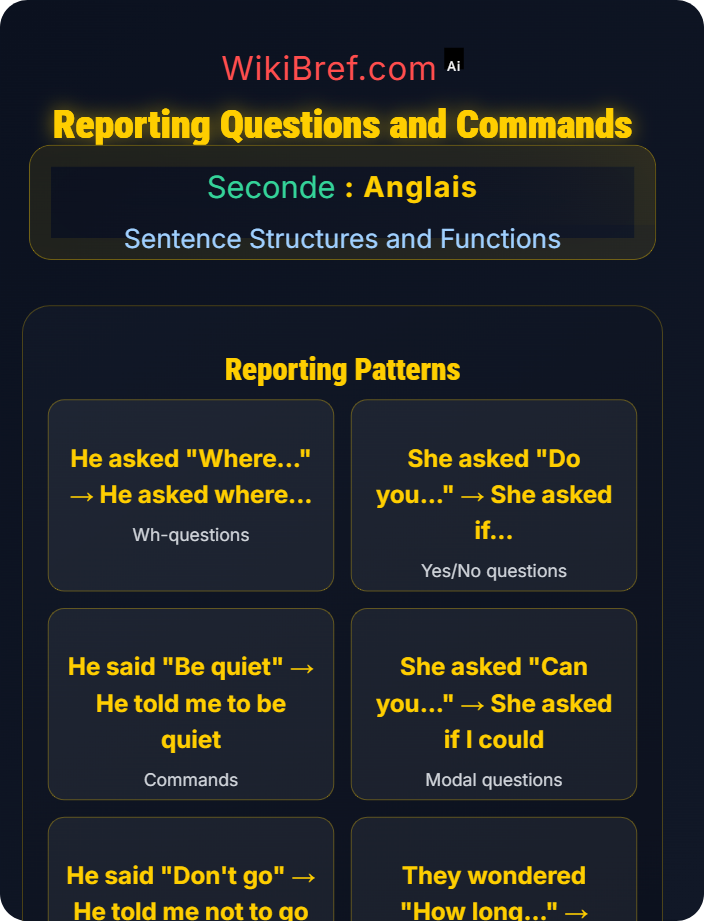
Yes/No question reporting: Converting questions that can be answered with yes or no to reported speech using "if" or "whether".
Replace question mark with "if/whether", change to normal word order, apply backshift
Direct: "He said, 'Do you like pizza?'"
"Do you like" is a yes/no question
"Do you like" → "if/whether you like"
Question order "Do you like" → Normal order "you like"
"like" (present) → "liked" (past) because reporting verb is "said"
"He asked if/whether I liked pizza"
Direct: "He said, 'Do you like pizza?'" → Reported: "He asked if/whether I liked pizza"
• Connector Rule: Yes/No questions use "if" or "whether"
• Word Order: Change question order to normal subject-verb order
• Backshift: Apply appropriate tense backshift
Wh-question reporting: Converting questions starting with question words (what, where, when, etc.) to reported speech keeping the question word.
Direct: "She asked, 'Where do you live?'"
"Where" is the question word
Retain "where" in reported speech
Question order "Where do you live?" → Normal order "where you live"
"do you live" → "did you live" → "lived"
"She asked where I lived"
Direct: "She asked, 'Where do you live?'" → Reported: "She asked where I lived"
• Question Word Retention: Keep wh-words in reported speech
• Normal Word Order: Change to subject-verb-object order
• Backshift Application: Apply appropriate tense changes
Command reporting: Converting imperative sentences to reported speech using "tell/ask/order + object + to + infinitive".
Direct: "He said, 'Open the door'"
"Open" is an imperative command
"said" → "told" (for commands/orders)
"He told me" (assuming "me" is the person addressed)
"to open the door"
"He told me to open the door"
Direct: "He said, 'Open the door'" → Reported: "He told me to open the door"
• Structure Pattern: Subject + reporting verb + object + to + infinitive
• Reporting Verb Choice: Tell (orders), ask (requests), order (formal commands)
• Infinitive Form: Always use "to" + base form of verb
Polite request reporting: Converting polite commands using "please" or modal requests to reported speech using "ask + object + to + infinitive".
Direct: "She said, 'Please sit down'"
Polite request with "please"
"said" → "asked" (more polite than "told")
"She asked me"
"to sit down"
Direct: "Could you help me?" → "She asked if I could help her"
Direct: "She said, 'Please sit down'" → Reported: "She asked me to sit down"
• Politeness Level: Use "ask" for polite requests, "tell" for direct commands
• Modal Requests: Treat as questions when using "could/would you"
• Context Sensitivity: Consider tone when selecting reporting verb
Suggestion/advice reporting: Converting suggestions and advice to reported speech using various structures.
Direct: "He said, 'Let's go shopping'"
Reported: "He suggested going shopping"
Or: "He suggested that we should go shopping"
Direct: "She said, 'You should study harder'"
Reported: "She advised me to study harder"
Or: "She told me I should study harder"
Direct: "He said, 'I recommend buying this book'"
Reported: "He recommended buying this book"
Or: "He recommended that I should buy this book"
Suggest, recommend, advise, propose, urge, encourage
Suggestions and advice use reporting verbs like "suggest", "recommend", "advise" followed by gerund or "that" clause with "should".
• Gerund Structure: Suggest/Recommend + -ing form
• That-Clause: Suggest/Recommend + that + subject + should + infinitive
• Advice Pattern: Advise + object + to + infinitive
Negative command reporting: Converting negative imperatives to reported speech using "not to" before the infinitive.
Direct: "He said, 'Don't smoke here'"
"Don't" indicates negative command
"said" → "told" (for negative commands)
"He told us"
"not to smoke here"
"He told us not to smoke here"
Direct: "He said, 'Don't smoke here'" → Reported: "He told us not to smoke here"
• Negative Structure: Subject + reporting verb + object + not to + infinitive
• Position of "Not": Between object and "to" infinitive
• Same Pattern: Follow same structure as positive commands
Modal question reporting: Converting questions containing modal verbs (can, could, will, would, etc.) to reported speech.
Direct: "He asked, 'Can you help me?'"
Reported: "He asked if I could help him"
(can → could)
Direct: "She asked, 'Where can I park?'"
Reported: "She asked where she could park"
(can → could)
Direct: "He asked, 'Will you come tomorrow?'"
Reported: "He asked if I would come the next day"
(will → would)
Apply both question reporting rules AND modal backshift rules
Modal questions follow both question reporting rules (normal word order, if/whether/wh-word) and modal backshift rules (can→could, will→would, etc.).
• Double Application: Apply question reporting AND modal backshift rules
• Modal Backshift: Can→could, will→would, may→might, etc.
• Word Order: Maintain normal word order after modal backshift
Reverse conversion: Changing reported questions and commands back to direct speech.
Reported: "He asked if I liked coffee"
Direct: "He said, 'Do you like coffee?'"
(if → ?, add "do" for present tense)
Reported: "She asked where I lived"
Direct: "She said, 'Where did you live?'"
(backshift reverse: lived → did you live)
Reported: "He told me to close the door"
Direct: "He said, 'Close the door'"
(remove "to", use imperative)
Reported: "She told us not to run"
Direct: "She said, 'Don't run'"
(add "don't" before verb)
To convert back: restore question order for questions, remove "to" and use imperative for commands, reverse tense backshift.
• Reverse Process: Undo backshift and word order changes
• Question Restoration: Add auxiliary verbs and question marks
• Command Restoration: Remove "to" and use base form
Complex question reporting: Handling questions with multiple clauses, conditionals, and complex tenses.
Direct: "He asked, 'Would you go if you had time?'"
Reported: "He asked if I would go if I had time"
(Both clauses backshift)
Direct: "She asked, 'Have you finished your work?'"
Reported: "She asked if I had finished my work"
(Present perfect → Past perfect)
Direct: "He asked, 'What do you think about this?'"
Reported: "He asked what I thought about it"
(Multiple backshifts)
Direct: "She asked, 'Did he say, "I will come"?'"
Reported: "She asked if he had said he would come"
Complex questions require applying reporting rules to each clause independently while maintaining logical relationships and proper backshifting.
• Clause Independence: Apply rules to each clause separately
• Consistent Backshift: Maintain tense logic throughout
• Logical Relationships: Preserve conditional and causal connections
Advanced mastery: Complex reporting scenarios including mixed question types, multiple embedded clauses, and sophisticated structures.
Direct: "He asked, 'Do you like it?' and 'Where did you buy it?'"
Reported: "He asked if I liked it and where I had bought it"
(Two separate reported questions)
Direct: "She ordered, 'Tell him that you're sorry'"
Reported: "She ordered me to tell him that I was sorry"
(Command + reported speech inside)
Direct: "He asked, 'What would you do if you won the lottery?'"
Reported: "He asked what I would do if I won the lottery"
(Conditional preserved)
Direct: "He asked, 'Are you here now?'"
Reported: "He asked if I was there then"
(Here→there, now→then)
Direct: "John told Mary, 'Ask him to call me'"
Reported: "John told Mary to ask him to call him"
(Pronoun reference depends on context)
Advanced scenarios require careful attention to all reporting rules simultaneously: word order, backshift, pronouns, time/place references, and complex clause relationships.
• Multi-Rule Application: Apply multiple rules simultaneously
• Context Sensitivity: Adjust pronouns and references based on context
• Complex Logic: Maintain logical consistency across all elements