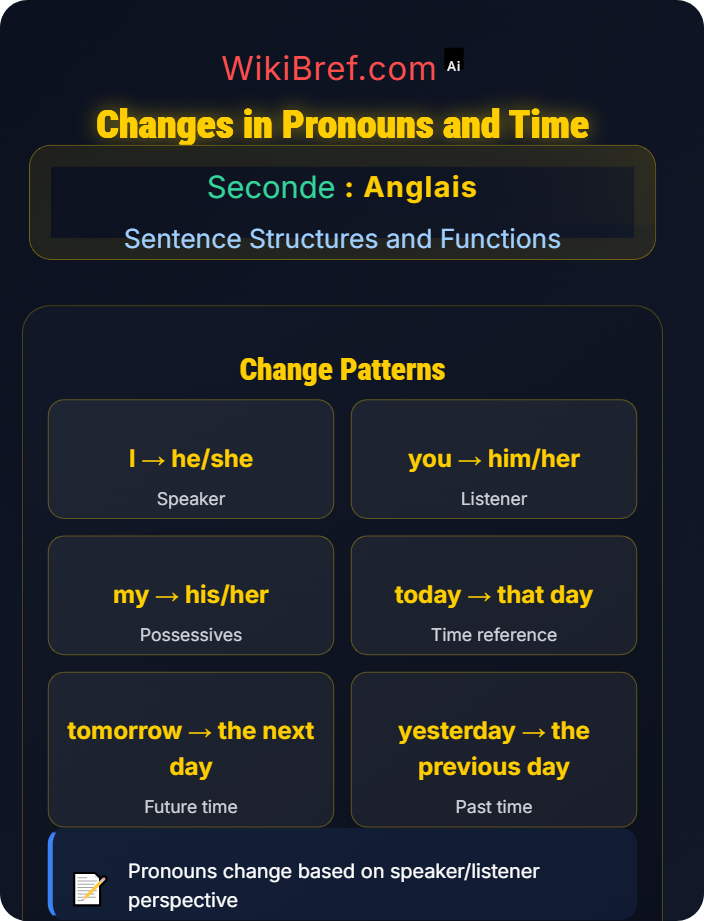
Personal pronoun changes: Adjusting "I", "you", "we", etc. based on the speaker and listener in reported speech.
Identify speaker and listener roles, then change pronouns accordingly
Direct: "John said to Mary, 'I love you'"
Speaker: John (I)
Listener: Mary (you)
In reported speech:
John → he
Mary → her
"I love you" → "he loves her"
"John told Mary he loved her"
Direct: "John said to Mary, 'I love you'" → Reported: "John told Mary he loved her"
• I → He/She: First person becomes third person
• You → Me/Him/Her: Second person becomes first/third depending on context
• Context Matters: Pronoun change depends on who is speaking to whom
Time expression changes: Adjusting temporal references like "today", "tomorrow", "yesterday" to match the reporting time.
Common expressions: today, tomorrow, yesterday, now, last week, next week
today → that day
tomorrow → the next day / the following day
yesterday → the day before / the previous day
now → then
last week → the week before
next week → the following week
Direct: "He said, 'I went yesterday'"
Reported: "He said he had gone the day before"
Direct: "She said, 'I will go tomorrow'"
Reported: "She said she would go the next day"
Time expressions change relative to the moment of reporting: today→that day, tomorrow→the next day, yesterday→the day before.
• Relative Timing: Time expressions relate to the reporting moment
• Consistency: All time expressions shift relative to reporting time
• Context Clues: Use "the" to clarify the new time reference
Place expression changes: Adjusting spatial references like "here", "there", "this", "that" to match the new perspective.
Common expressions: here, there, this, that, these, those
here → there
this → that
these → those
here → there (depends on context)
Direct: "He said, 'I am here'"
Reported: "He said he was there"
Direct: "She said, 'Put this book here'"
Reported: "She told me to put that book there"
Place expressions change relative to the new reporting perspective: here→there, this→that, these→those.
• Deictic Shift: Spatial references change with perspective
• Relative Distance: Near things become far things in reported speech
• Context Dependency: Changes depend on reporting speaker's position
Multiple people: Managing pronoun changes when more than two people are involved in the conversation.
Direct: "Tom said to Mary and Jane, 'We will meet here tomorrow'"
Tom (speaker) = I
Mary and Jane (listeners) = you
Others = they
In reported speech, Tom becomes "he"
Mary and Jane become "them"
"We" (Tom + others) becomes "they"
"We will meet here tomorrow" → "they would meet there the next day"
"Tom told Mary and Jane they would meet there the next day"
When multiple people are involved, "we" typically becomes "they" and listeners become objects in reported speech.
• Group References: "We" often becomes "they" in reported speech
• Multiple Listeners: Become objects of the reporting verb
• Role Clarity: Maintain clear understanding of who is who
Complex time expressions: Handling compound and relative time references in reported speech.
Examples: "the day before yesterday", "next month", "last Monday", "in a week", "two days ago"
the day before yesterday → two days before
last Monday → the Monday before
next month → the following month
in a week → in a week (relative to reporting time)
two days ago → two days before
Direct: "He said, 'I arrived the day before yesterday'"
Reported: "He said he had arrived two days before"
Direct: "She said, 'I'll see you in a week'"
Reported: "She said she would see me in a week"
(Still relative to the original speaking time)
Complex time expressions change similarly to simple ones, but maintain their relative relationship to the original speaking time.
• Compound Times: Break down complex expressions into components
• Relative Maintenance: Keep the relative relationship intact
• Context Sensitivity: Some expressions may remain unchanged
Possessive pronoun changes: Adjusting "my", "your", "his", "her", etc. in reported speech.
Direct: "John said, 'My car is fast'"
"My" needs to change to match John's perspective
my → his/her/their (depending on the original speaker)
your → my/his/her/their (depending on context)
our → their (group possession)
Direct: "Mary said, 'My house is big'"
Reported: "Mary said her house was big"
Direct: "John said to Mary, 'Your book is on my desk'"
Reported: "John told Mary her book was on his desk"
(John's perspective: "my" → "his")
Possessive pronouns change to reflect the original speaker's perspective: my→his/her, your→my/his/her depending on context.
• Speaker Ownership: Possessive reflects original speaker's ownership
• Context Dependency: "Your" changes based on who originally spoke to whom
• Consistency: Maintain possessive relationships in reported speech
Relative time expressions: Handling time references that are relative to other time points.
Examples: "the following day", "the previous week", "the next month", "the day after", "the week before"
Direct: "He said, 'I'll go the day after tomorrow'"
Reported: "He said he would go two days after"
(Maintains the relative relationship)
Direct: "She said, 'I went the week before last'"
Reported: "She said she had gone two weeks before"
Direct: "He said, 'I'll finish in three weeks'"
Reported: "He said he would finish in three weeks"
(Still relative to original speaking time)
Relative time expressions maintain their relative relationship but shift in reference from the original speaking time to the reporting time.
• Relationship Preservation: Keep the relative timing intact
• Reference Point Shift: Change the reference point from original to reported
• Proportional Adjustment: Maintain proportional time relationships
Direction/location changes: Adjusting directional and location references in reported speech.
Examples: up/down, left/right, near/far, in/out, above/below
up → up (but context-dependent)
down → down (but context-dependent)
left → his/her left (specify perspective)
right → his/her right (specify perspective)
Direct: "He said, 'Go straight and turn left'"
Reported: "He told me to go straight and turn left"
(Direction relative to listener's perspective)
Direct: "She said, 'I live upstairs'"
Reported: "She said she lived upstairs"
(Upstairs relative to speaker's location)
Directional expressions often remain the same but may need clarification of perspective, while location references change based on the new reporting context.
• Perspective Clarity: Some directions need specification of whose perspective
• Context Sensitivity: Many directions remain unchanged if context is clear
• Relative Positioning: Maintain positional relationships in reported speech
Complex structures: Applying all changes (pronouns, time, place) in complex reported speech with multiple clauses.
Direct: "John said to Mary, 'I will go to my office here tomorrow and I'll call you'"
Reported: "John told Mary he would go to his office there the next day and he would call her"
Direct: "She said, 'I live here and I work there'"
Reported: "She said she lived there and she worked there"
(Both locations change relative to reporting context)
Direct: "He said, 'Yesterday I went to town and tomorrow I'll return'"
Reported: "He said the day before he had gone to town and the following day he would return"
Direct: "Tom told Peter, 'Tell Susan I'll meet her here'"
Reported: "Tom told Peter to tell Susan he would meet her there"
(Multiple pronoun and place changes)
Complex reported speech requires applying all changes systematically: pronouns, time expressions, and place expressions in each relevant clause.
• Systematic Application: Apply all changes to each relevant part
• Clause-by-Clause: Handle each clause individually
• Consistency: Maintain consistent perspective throughout
Advanced mastery: Complex scenarios involving multiple embedded clauses, hypothetical situations, and sophisticated pronoun/time adjustments.
Direct: "He said, 'I know that she said, "I will go tomorrow"'"
Reported: "He said he knew that she had said she would go the next day"
(Multiple levels of changes)
Direct: "She said, 'If I were there, I would help them'"
Reported: "She said if she were there, she would help them"
(Conditionals often remain unchanged)
Direct: "He said, 'I started yesterday and I'll finish tomorrow'"
Reported: "He said he had started the day before and he would finish the next day"
(Different time expressions for different parts)
Direct: "She said, 'Today is Christmas'"
Reported: "She said that day was Christmas"
(May remain unchanged if the date is still relevant)
Some expressions don't change if the context remains the same:
"He said, 'I am American'" → "He said he is American"
(Nationality doesn't change)
Advanced scenarios require careful consideration of all elements: pronouns, time, place, and context, with special attention to exceptions and embedded structures.
• Layered Complexity: Handle nested clauses with systematic changes
• Context Sensitivity: Some expressions remain unchanged if still true
• Logical Consistency: Maintain logical relationships throughout