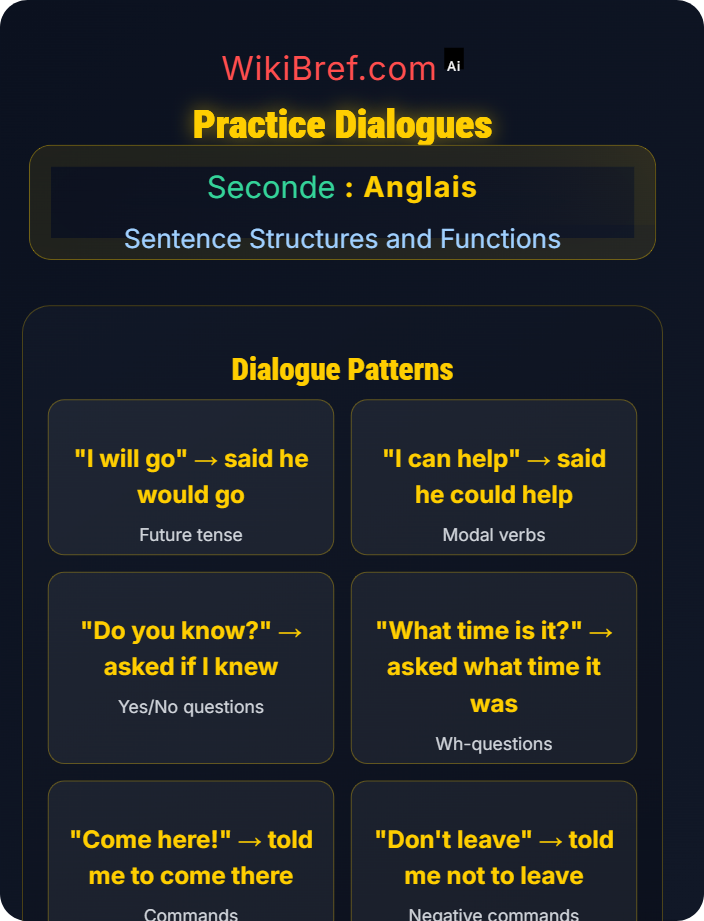
Simple dialogue reporting: Converting basic two-person conversations to reported speech while adjusting pronouns and tenses.
Identify speakers, change pronouns, apply tense backshift, adjust time/place expressions
Direct dialogue: "John said to Mary, 'I love you'"
Speaker: John (I)
Listener: Mary (you)
"I" (John) → "he"
"you" (Mary) → "her"
"love" (present) → "loved" (past)
"John told Mary he loved her"
John: "I love you"
Mary: "I love you too"
John told Mary he loved her, and Mary said she loved him too
Direct: "John said to Mary, 'I love you'" → Reported: "John told Mary he loved her"
• Pronoun Shift: I→he, you→her based on speaker/listener roles
• Tense Backshift: Present→Past when reporting verb is past
• Reporting Verb: Use "told" for direct communication
Question-answer reporting: Converting question and response exchanges to reported speech using appropriate connectors.
Yes/No question: "Do you like coffee?" → "if/whether"
Wh-question: "Where do you live?" → "where"
Question order "Do you like" → Normal order "you like"
"do you live" → "did you live" → "lived"
Adjust the answer with appropriate pronouns and tenses
Tom: "Do you like pizza?"
Sarah: "Yes, I love it"
Tom asked Sarah if she liked pizza, and she said yes, she loved it
Direct: "Tom asked, 'Do you like pizza?' Sarah replied, 'Yes, I love it'" → Reported: "Tom asked Sarah if she liked pizza, and she said yes, she loved it"
• Question Connectors: Yes/No → if/whether, Wh- → keep question word
• Word Order: Change to normal subject-verb order
• Pronoun Adjustment: Adjust based on speaker/listener roles
Command-response reporting: Converting imperative sentences and responses to reported speech using "to" infinitive structures.
Command: "Open the door" → "told/asked + object + to + infinitive"
Commands: "told"
Requests: "asked"
Suggestions: "suggested"
"Open" → "to open"
Adjust responses with appropriate pronouns and tenses
Teacher: "Sit down!"
Student: "Okay, I will"
The teacher told the student to sit down, and the student agreed that he would
Direct: "Teacher said, 'Sit down!' Student replied, 'Okay, I will'" → Reported: "The teacher told the student to sit down, and the student agreed that he would"
• Imperative Structure: Subject + reporting verb + object + to + infinitive
• Reporting Verb Choice: Tell (commands), ask (requests), suggest (suggestions)
• Response Adjustment: Apply all standard reported speech changes
Multi-person dialogue reporting: Converting conversations among three or more people to reported speech.
Direct: "John said to Mary and Tom, 'We should go to the cinema'"
John (speaker) = I → he
Mary and Tom (listeners) = you → them
"We" (John + others) → "they" in reported speech
Pronouns, tenses, time, and place expressions
Handle each person's response individually
John: "We should go to the cinema"
Mary: "Good idea"
Tom: "I agree"
John suggested they should go to the cinema, Mary agreed it was a good idea, and Tom said he agreed
Direct: "John said to Mary and Tom, 'We should go to the cinema'" → Reported: "John told Mary and Tom they should go to the cinema"
• Group Pronouns: We → they, you (plural) → them
• Multiple Listeners: Become objects of reporting verb
• Individual Responses: Handle each separately with appropriate changes
Time expression reporting: Adjusting temporal references in dialogue reporting to match the reporting time.
Common: today, tomorrow, yesterday, now, last week, next week
today → that day
tomorrow → the next day
yesterday → the day before
now → then
last week → the week before
next week → the following week
Keep the temporal relationship clear in reported speech
Relative time expressions like "the day after tomorrow"
John: "I went to London yesterday"
Mary: "When will you return?"
John: "Tomorrow"
John told Mary he had gone to London the day before. Mary asked when he would return, and John said the next day
Time expressions change relative to the reporting time: today→that day, tomorrow→the next day, yesterday→the day before.
• Temporal Shift: Time expressions relate to the reporting moment
• Consistency: All time expressions shift relative to reporting time
• Context Clarity: Use "the" to clarify new time references
Place expression reporting: Adjusting spatial references in dialogue reporting to match the new perspective.
Common: here, there, this, that, these, those
here → there
this → that
these → those
here → there (depends on context)
Up/down, left/right may stay the same if context is clear
Specific places may need additional context in reported speech
Tourist: "Where is the museum?"
Guide: "It's here, next to this building"
Tourist: "How do I get there from here?"
The tourist asked where the museum was. The guide said it was there, next to that building, and the tourist asked how he could get there from there
Place expressions change relative to the new reporting perspective: here→there, this→that, these→those.
• Deictic Shift: Spatial references change with perspective
• Relative Distance: Near things become far things in reported speech
• Context Dependency: Changes depend on reporting speaker's position
Complex time references: Handling compound and relative time expressions in dialogue reporting.
Examples: "the day before yesterday", "last Monday", "next month", "in two weeks"
The day before yesterday → two days before
Last Monday → the Monday before
Next month → the following month
In two weeks → in two weeks (relative to original time)
Keep the temporal relationship intact in reported speech
Each time expression needs to be adjusted independently
John: "I went to Paris three days ago"
Mary: "How long did you stay?"
John: "I came back yesterday"
John told Mary he had gone to Paris three days before. Mary asked how long he had stayed, and John said he had come back the day before
Complex time expressions change similarly to simple ones but maintain their relative relationship to the original speaking time.
• Compound Times: Break down complex expressions into components
• Relative Maintenance: Keep the relative relationship intact
• Context Sensitivity: Some expressions may remain unchanged
Possessive reporting: Adjusting possessive pronouns in dialogue reporting based on the original speaker.
Direct: "John said, 'My car is blue'"
"My" belongs to John
my → his/her/their (based on original speaker)
your → my/his/her/their (based on context)
our → their (group possession)
Each speaker's possessions change to match their perspective
The context determines which possessive pronoun to use
John: "My house is big"
Mary: "Your car is nice"
John: "Thanks, I bought it last year"
John said his house was big. Mary told him his car was nice, and John thanked her and said he had bought it the year before
Possessive pronouns change to reflect the original speaker's perspective: my→his/her, your→his/her/my depending on context.
• Ownership Perspective: Possessive reflects original speaker's ownership
• Context Dependency: "Your" changes based on who originally spoke to whom
• Consistency: Maintain possessive relationships in reported speech
Complex structures: Handling dialogues with multiple clauses, conditionals, and complex tenses in reported speech.
Direct: "John said, 'I will go if it doesn't rain'"
Two clauses: main and conditional
Main clause: "I will go" → "he would go"
Conditional: "if it doesn't rain" → "if it didn't rain"
Second conditional often remains unchanged
Third conditional also remains as past perfect
Keep the relationship between clauses intact
John: "I will go to the party if Mary comes"
Mary: "If I come, will you drive?"
John: "Yes, I'll pick you up"
John said he would go to the party if Mary came. Mary asked if she came, whether he would drive, and John said yes, he would pick her up
Complex dialogues require applying all reported speech rules to each clause independently while maintaining logical relationships.
• Clause Independence: Apply rules to each clause separately
• Conditional Preservation: Some conditionals don't change
• Logical Consistency: Maintain relationships between clauses
Advanced mastery: Complex dialogue scenarios including mixed tenses, embedded quotes, and sophisticated reporting structures.
Direct: "John said, 'I know that Mary said, "I will come tomorrow"'"
Reported: "John said he knew that Mary had said she would come the next day"
(Multiple levels of changes)
Direct: "John said, 'I have lived here for five years, but I moved here last year'"
Reported: "John said he had lived there for five years, but he had moved there the year before"
Direct: "She said, 'If I were rich, I would travel, but I'm not'"
Reported: "She said if she were rich, she would travel, but she wasn't"
Some expressions remain unchanged if the context is still relevant:
"I am American" → "He said he is American" (if still true)
Universal truths, habitual facts, and still-current situations may not change
Teacher: "Water boils at 100°C, and I demonstrated this yesterday"
Student: "How do you know?"
Teacher: "I studied chemistry, and it's a scientific fact"
The teacher said water boils at 100°C and he had demonstrated that the day before. The student asked how he knew, and the teacher said he had studied chemistry and it was a scientific fact
Advanced scenarios require careful application of all reported speech rules with special attention to exceptions and embedded structures.
• Layered Complexity: Handle nested clauses with systematic changes
• Context Sensitivity: Some expressions remain unchanged if still true
• Logical Consistency: Maintain logical relationships throughout