Différences fondamentales
IMPERFECTO ≠ PERFECTO
Contraste entre les deux temps
| Caractéristique | Imperfecto | Perfecto |
|---|---|---|
| Aspect | Action continue/inachevée | Action achevée/ponctuelle |
| Contexte | Description/passé habituel | Événement spécifique |
| Marqueurs | Siempre, todos los días... | Ayer, esta mañana, ya... |
| Exemple | Yo estudiaba español | Yo estudié español ayer |
Concepts clés
Imperfecto = Continuité
Perfecto = Achèvement
Imperfecto = Contexte
Perfecto = Événement
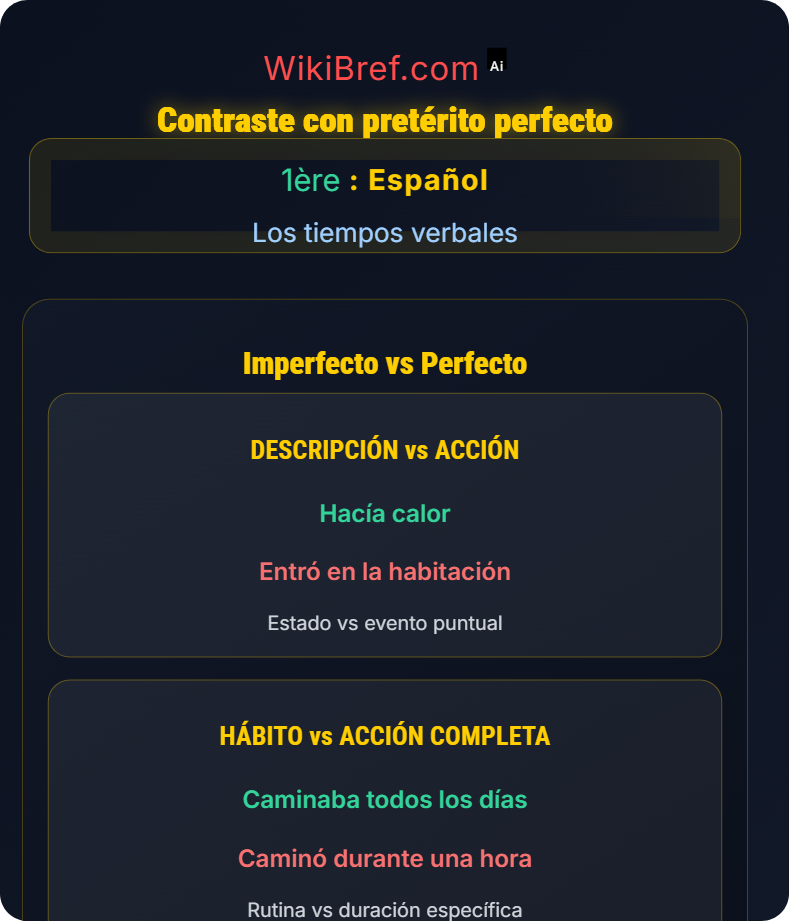
Imperfecto vs Perfecto
Imperfecto (habitudes passées):
Cuando era niño, jugaba en el parque → When I was a child, I used to play in the park
Mi madre cocinaba todos los días → My mother used to cook every day
Siempre estudiábamos juntos → We always used to study together
Mi madre cocinaba todos los días → My mother used to cook every day
Siempre estudiábamos juntos → We always used to study together
Perfecto (actions ponctuelles):
Ayer estudié toda la noche → Yesterday I studied all night
Ya terminé mi tarea → I already finished my homework
Esta mañana comí en casa → This morning I ate at home
Ya terminé mi tarea → I already finished my homework
Esta mañana comí en casa → This morning I ate at home
Description vs Événement
Imperfecto (description):
Era un día soleado → It was a sunny day
La niña tenía ocho años → The girl was eight years old
Hacía calor en la calle → It was hot in the street
La niña tenía ocho años → The girl was eight years old
Hacía calor en la calle → It was hot in the street
Perfecto (événement):
Vi un pájaro raro → I saw a strange bird
Llegué a las ocho → I arrived at eight
Terminó la película → The movie ended
Llegué a las ocho → I arrived at eight
Terminó la película → The movie ended
Combinaisons possibles
Contexte + Événement:
Mientras yo estudiaba (imperfecto), mi hermano llegó (perfecto) → While I was studying, my brother arrived
Cuando tenía ocho años (imperfecto), vi esa película (perfecto) → When I was eight years old, I saw that movie
Estaba lloviendo (imperfecto) cuando salí (perfecto) → It was raining when I went out
Cuando tenía ocho años (imperfecto), vi esa película (perfecto) → When I was eight years old, I saw that movie
Estaba lloviendo (imperfecto) cuando salí (perfecto) → It was raining when I went out
Deux événements simultanés:
Mientras uno estudiaba, otro dormía → While one was studying, the other was sleeping
Al mismo tiempo que hablaba, escribía → At the same time as speaking, I was writing
Al mismo tiempo que hablaba, escribía → At the same time as speaking, I was writing
Erreurs fréquentes
Erreur 1:
Utiliser le perfecto pour des habitudes passées
Erreur 2:
Confondre les contextes d'utilisation
Erreur 3:
Ne pas distinguer actions continues et ponctuelles
Astuces & Méthodes
Imperfecto = Habitudes passées
Perfecto = Actions achevées
Imperfecto = Description
Perfecto = Événements spécifiques
Contexte détermine le choix