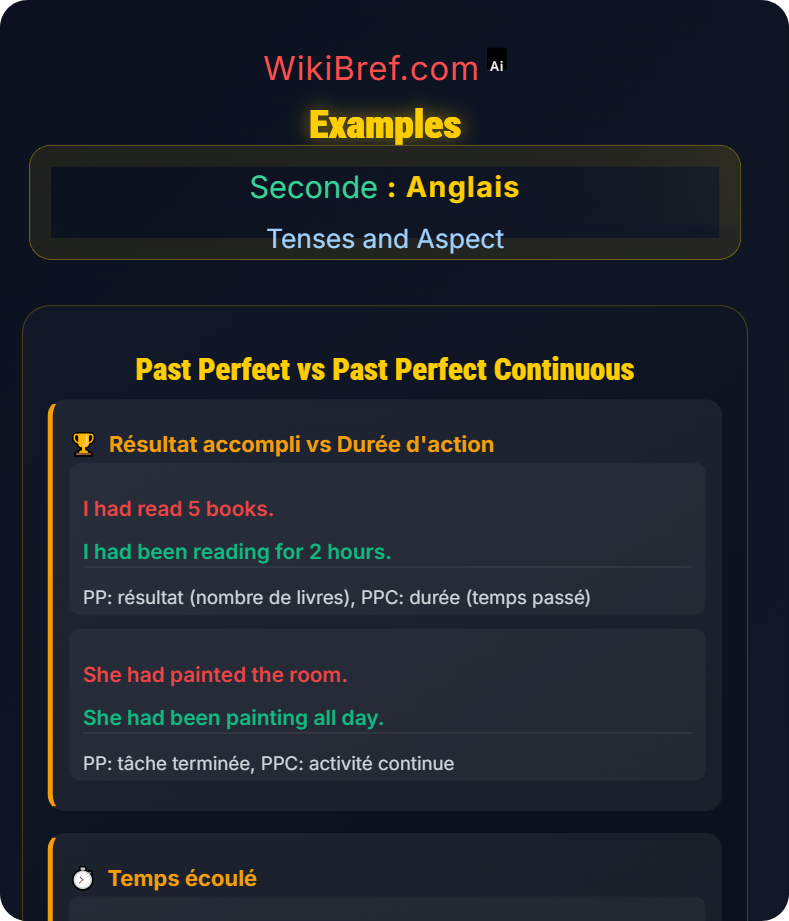
Exemples Past Perfect
Past Perfect: Subject + had + past participle
Action achevée avant une autre action passée
Narration
Cause/effet
Expérience
Conditionnel
Narration :
When I arrived at the cinema, the movie had already started.
She had finished her homework before going out.
She had finished her homework before going out.
Cause/effet :
He failed the exam because he hadn't studied enough.
The ground was wet because it had rained during the night.
The ground was wet because it had rained during the night.
Expérience :
By the time I was 20, I had traveled to five countries.
She had never seen snow before moving to Canada.
She had never seen snow before moving to Canada.
Conditionnel :
If I had known, I would have helped you.
She would have been happier if she had stayed longer.
She would have been happier if she had stayed longer.
Exemples Past Perfect Continuous
Past Perfect Continuous: Subject + had + been + verb + -ing
Action continue avant une autre action passée
Durée
Effort
Cause physique
Intensité
Durée :
When the meeting ended, I had been sitting for 3 hours.
She had been learning French for 2 years before moving to Paris.
She had been learning French for 2 years before moving to Paris.
Effort/cause physique :
His clothes were dirty because he had been working in the garden.
Her eyes were red because she had been crying all morning.
Her eyes were red because she had been crying all morning.
Intensité :
When I saw him, he had been running for 30 minutes.
She looked tired because she had been studying all night.
She looked tired because she had been studying all night.
Cause d'état :
The children were exhausted because they had been playing all day.
He was nervous because he had been waiting for hours.
He was nervous because he had been waiting for hours.
Définitions clés
Past Perfect: Action achevée avant une autre action passée
Past Perfect Continuous: Action continue avant une autre action passée
Past Perfect = Résultat
Past Perfect Continuous = Durée/Effort
Comparaison des exemples
Past Perfect = Quantité achevée
Past Perfect Continuous = Durée continue
Focus sur le résultat vs le processus
Verbes d'action vs verbes d'état
Contexte détermine le choix
Exemples comparés
Past Perfect :
"I had written 5 letters." (Quantité achevée)
"He had cleaned the house." (Résultat visible)
"He had cleaned the house." (Résultat visible)
Past Perfect Continuous :
"I had been writing letters for 2 hours." (Durée continue)
"He had been cleaning the house all morning." (Effort/intensité)
"He had been cleaning the house all morning." (Effort/intensité)
Contexte déterminant :
"When I saw her, she had been cooking." (Effort visible, odeur)
"When I saw her, she had cooked dinner." (Résultat, repas prêt)
"When I saw her, she had cooked dinner." (Résultat, repas prêt)
Erreurs fréquentes
Erreur 1 :
Confusion entre résultat et durée
Erreur 2 :
Verbes d'état avec Past Perfect Continuous
Erreur 3 :
Mauvaise interprétation du contexte