Will - Formation et Usage
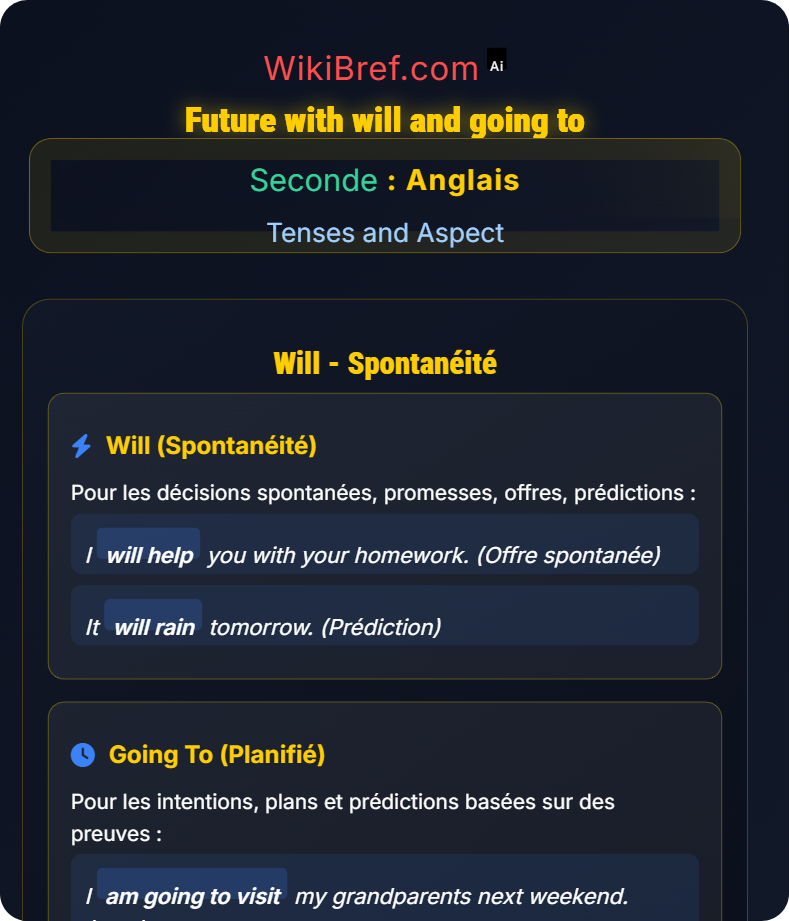
Will: Subject + will + base verb
I will go / She will study
Promesse
Prédiction
Offre spontanée
Volonté soudaine
Promesses :
I will call you tomorrow.
She will finish her project by Friday.
She will finish her project by Friday.
Prédictions :
It will rain later today.
He will become a great doctor someday.
He will become a great doctor someday.
Offres spontanées :
I'll help you with your bags.
I'll answer the phone.
I'll answer the phone.
Going To - Formation et Usage
Going To: Subject + am/is/are + going to + base verb
I am going to study / She is going to travel
Planification
Intention
Preuve visible
Décision prévue
Plans/intentions :
I'm going to visit my grandparents next week.
We're going to start a new project soon.
We're going to start a new project soon.
Preuve visible :
Look at those clouds! It's going to rain.
He's going to fall - he's walking too close to the edge.
He's going to fall - he's walking too close to the edge.
Définitions clés
Will: Décision spontanée ou prédiction
Going To: Plan ou intention existante
Will = Impulsion soudaine
Going To = Décision prévue
Comparaison Will vs Going To
| Critère | Will | Going To |
|---|---|---|
| Décision | Spontanée | Prévue |
| Plan | Sans plan préalable | Avec plan/intention |
| Prédiction | Opinion subjective | Basée sur preuve |
| Offre/aide | Offre spontanée | Non applicable |
Will = Décision prise maintenant
Going To = Décision déjà prise
Prédiction + preuve = Going To
Spontanéité = Will
Contexte détermine le choix
Exemples comparés
Spontanéité vs Plan :
Will: "I'll open the door." (personne sonne)
Going To: "I'm going to open the door at 9 AM." (planifié)
Going To: "I'm going to open the door at 9 AM." (planifié)
Prédiction :
Will: "I think it will be sunny tomorrow." (opinion)
Going To: "It's going to snow - look at the sky!" (preuve visible)
Going To: "It's going to snow - look at the sky!" (preuve visible)
Offre spontanée :
Will: "I'll carry your luggage." (offre spontanée)
Going To: "I'm going to help you later." (intention prévue)
Going To: "I'm going to help you later." (intention prévue)