Formation et Règles
Would + Base Verb: Subject + would + base verb
I would go / She would study
Type 1
Type 2
Type 3
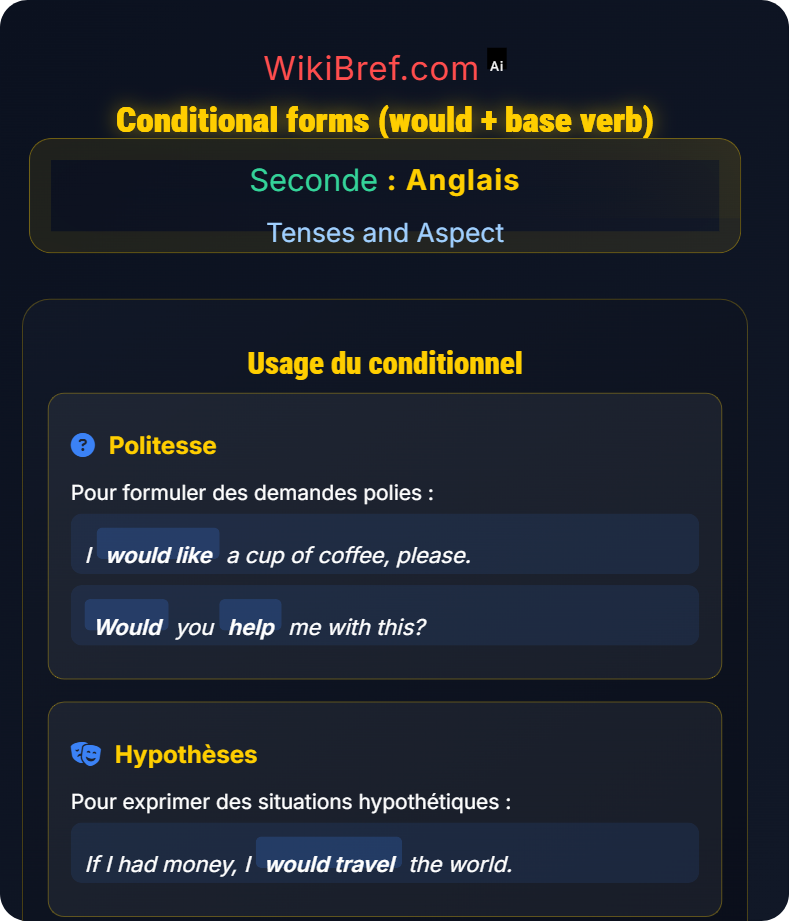
Politesse
Structure de base :
Affirmatif: I would eat / You would go
Négatif: I would not eat / You wouldn't go
Interrogatif: Would you eat? / Would I go?
Négatif: I would not eat / You wouldn't go
Interrogatif: Would you eat? / Would I go?
Contractions :
I'd, you'd, he'd, she'd, it'd, we'd, they'd
I wouldn't, you wouldn't, etc.
I wouldn't, you wouldn't, etc.
Usages et Significations
Type 2: Condition impossible/souhait
Type 3: Hypothèse sur le passé
Politesse: Demande/offre courtois
Hypothétique: Si + condition
Type 2 - Condition impossible :
If I were rich, I would travel the world.
If I had time, I would help you.
If I had time, I would help you.
Type 3 - Hypothèse sur le passé :
If I had studied harder, I would have passed.
If she had arrived earlier, she would have seen him.
If she had arrived earlier, she would have seen him.
Définitions clés
Would: Forme conditionnelle de will
Base verb: Infinitif sans to
Conditionnel: Expression d'hypothèse
Politesse: Langage formel
Exemples et Astuces
Type 2 = Présent irréaliste
Type 3 = Passé hypothétique
If + past simple → would + base verb
Politesse: Would you...?
Base verb jamais au passé
Exemples pratiques
Politesse :
Would you like some coffee?
I would appreciate your help.
I would appreciate your help.
Souhaits impossibles :
I would live in Paris if I could.
She would speak French fluently if she practiced more.
She would speak French fluently if she practiced more.
Regrets sur le passé :
I would have studied harder if I had known the exam was difficult.
He would have called if he had had your number.
He would have called if he had had your number.
Erreurs fréquentes
Erreur 1 :
Utiliser le passé avec would (should be base verb)
Erreur 2 :
Confusion entre Type 2 et Type 3
Erreur 3 :
Oubli de la structure if...would