Formes du Futur
Will: Subject + will + base verb
I will go / She will study
Going To: Subject + am/is/are + going to + base verb
I am going to study / She is going to travel
Certitude
Décision spontanée
Prédiction
Planification
Futur certain :
I will finish my homework tonight.
The sun will rise tomorrow morning.
The sun will rise tomorrow morning.
Décision spontanée :
I'll help you with that right now.
Don't worry, I'll take care of it.
Don't worry, I'll take care of it.
Formes du Conditionnel
Would: Subject + would + base verb
I would go / She would study
Hypothèse
Condition
Politesse
Impossibilité
Condition impossible :
If I were rich, I would buy a house.
I would travel if I had money.
I would travel if I had money.
Politesse :
Would you like some tea?
I would appreciate your help.
I would appreciate your help.
Passé hypothétique :
If I had studied, I would have passed.
She would have come if she had known.
She would have come if she had known.
Définitions clés
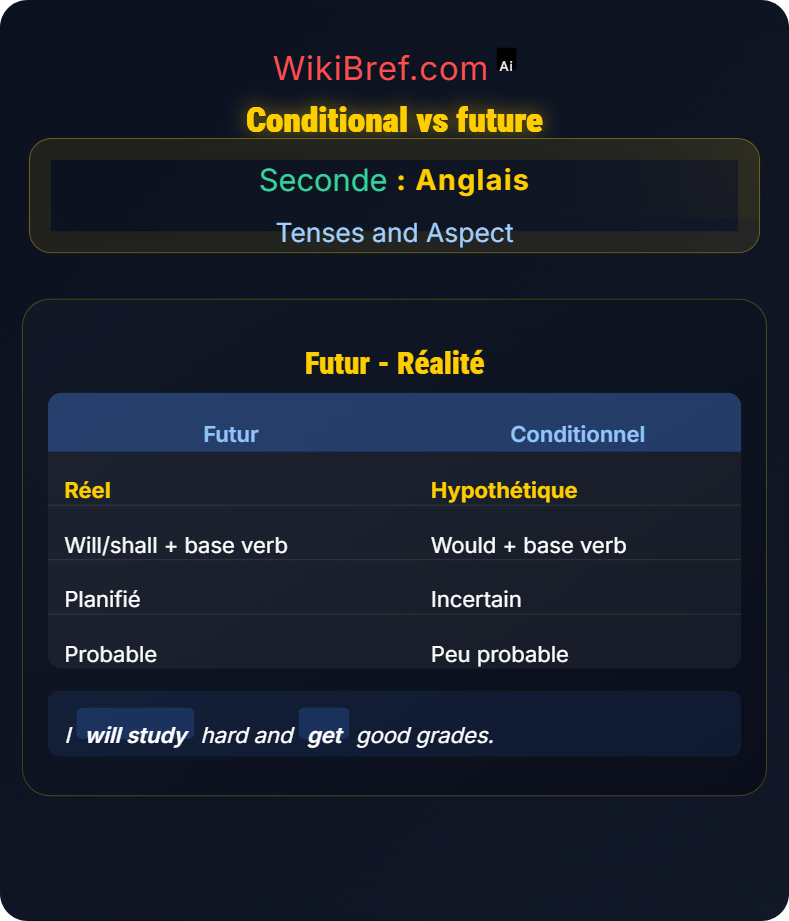
Futur: Événement réel ou probable
Conditionnel: Événement hypothétique
Will = Certitude
Would = Incertitude
Comparaison et Différences
| Aspect | Futur (Will) | Conditionnel (Would) |
|---|---|---|
| Certitude | Événement probable/réel | Événement hypothétique |
| Condition | Indépendant | Dépend d'une condition |
| Temps | Événement futur | Événement irréel |
| Usage | Plan/décision | Souhait/politesse |
Will = Événement certain
Would = Événement incertain
If clause = Conditionnel
Décision spontanée = Will
Politesse = Would
Exemples comparés
Futur vs Conditionnel :
Will: "I will call you tomorrow." (décision ferme)
Would: "I would call you if I had time." (condition)
Would: "I would call you if I had time." (condition)
Certitude vs Hypothèse :
Will: "It will rain later." (prédiction)
Would: "It would rain if the clouds were darker." (condition)
Would: "It would rain if the clouds were darker." (condition)
Politesse :
Will: "I will help you." (décision ferme)
Would: "I would be happy to help." (poli)
Would: "I would be happy to help." (poli)