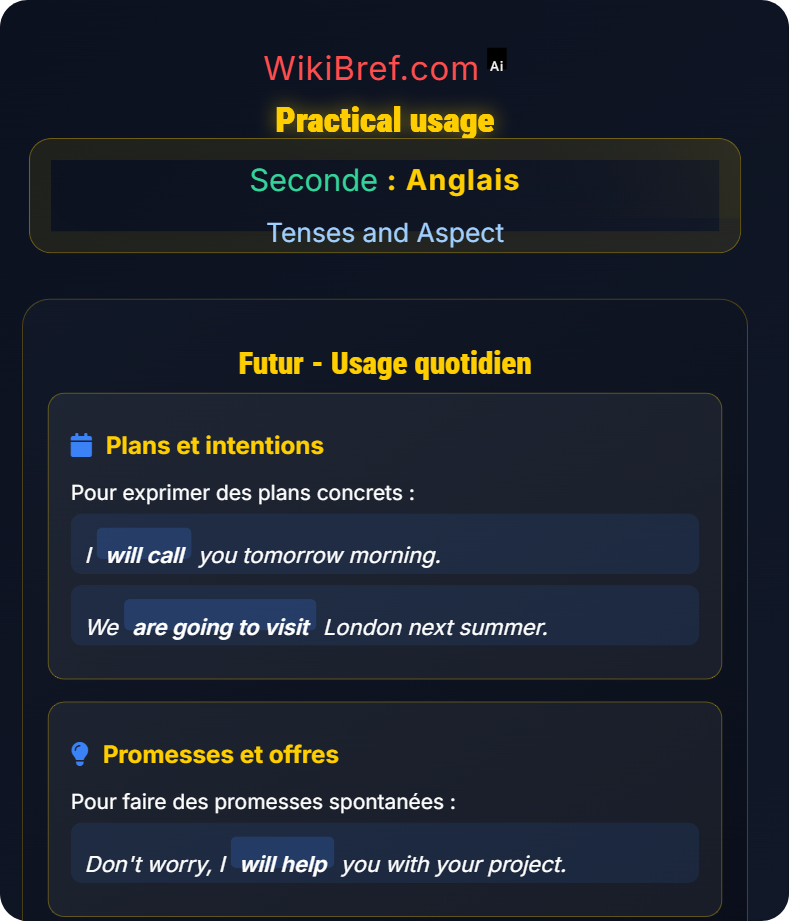
Utilisation pratique du futur
Will: Promesses, décisions spontanées, prédictions
Going To: Plans, intentions, preuves visibles
Conversation
Planification
Promesses
Prédictions
Décisions spontanées :
"I'll help you with that!" (quelqu'un demande de l'aide)
"I'll open the door." (personne sonne)
"I'll open the door." (personne sonne)
Plans/intentions :
"I'm going to visit my grandmother next weekend."
"We're going to start our new project soon."
"We're going to start our new project soon."
Prédictions avec preuve :
"Look at those clouds! It's going to rain."
"He's going to fall if he doesn't pay attention."
"He's going to fall if he doesn't pay attention."
Utilisation pratique du conditionnel
Would: Politesse, hypothèses, regrets, habitudes passées
Politesse
Hypothèses
Souhaits
Regrets
Politesse :
"Would you like some tea?"
"I would appreciate your help."
"I would appreciate your help."
Conditions impossibles :
"If I were rich, I would travel the world."
"I would speak French fluently if I practiced more."
"I would speak French fluently if I practiced more."
Regrets sur le passé :
"If I had studied harder, I would have passed."
"She would have come if she had known about the party."
"She would have come if she had known about the party."
Habitudes passées :
"When I was young, I would play football every day."
"My grandfather would tell us stories in the evening."
"My grandfather would tell us stories in the evening."
Définitions clés
Futur: Événements probables ou plans
Conditionnel: Événements hypothétiques
Will = Décision immédiate
Would = Si + condition
Conseils pratiques
Will pour décisions spontanées
Going To pour plans prévus
Would pour politesse
If clause = Conditionnel
Contexte détermine le choix
Situations courantes
Au téléphone :
"I'll call you back later." (décision)
"Would you mind holding for a moment?" (politesse)
"Would you mind holding for a moment?" (politesse)
En voyage :
"I'm going to visit the Eiffel Tower tomorrow." (plan)
"I would love to see more of Paris if I had more time." (souhait)
"I would love to see more of Paris if I had more time." (souhait)
Au travail/école :
"I'll finish the report by Friday." (promesse)
"I would have done better if I had more time." (regret)
"I would have done better if I had more time." (regret)
Dans la vie quotidienne :
"I'm going to cook dinner tonight." (intention)
"I would help if I weren't so busy." (condition)
"I would help if I weren't so busy." (condition)
Erreurs fréquentes
Erreur 1 :
Confusion entre will et going to dans les contextes
Erreur 2 :
Utilisation incorrecte de would dans les prédictions
Erreur 3 :
Oubli de la structure if...would