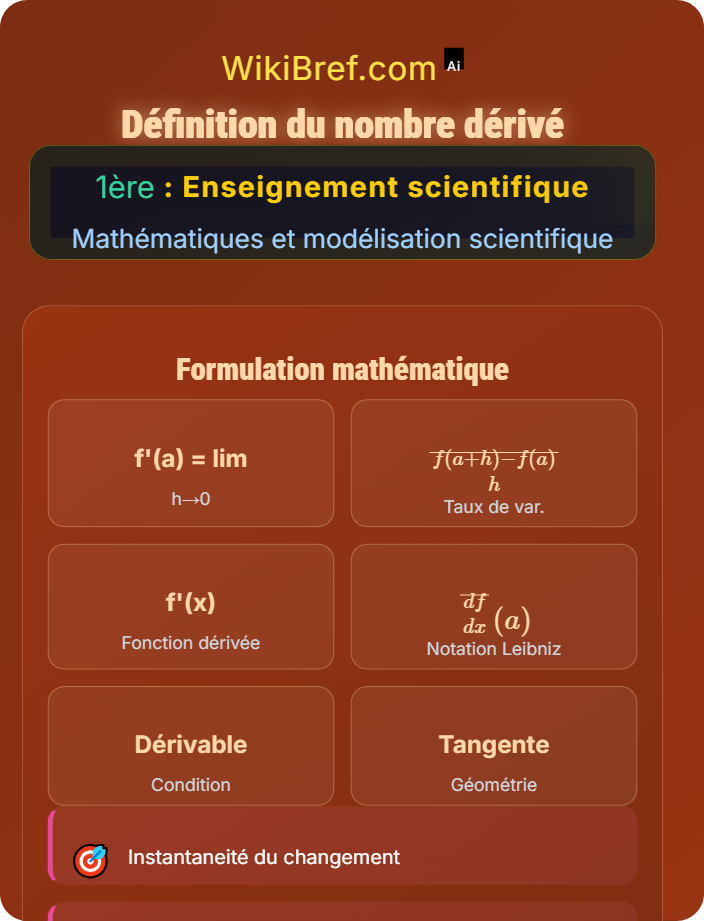
Nombre dérivé : \(f'(a) = \lim_{h \to 0} \frac{f(a+h) - f(a)}{h}\)
f(x) = 3x + 1, on cherche f'(2)
f(2) = 3(2) + 1 = 7, f(2+h) = 3(2+h) + 1 = 6 + 3h + 1 = 7 + 3h
\(\frac{f(2+h) - f(2)}{h} = \frac{(7 + 3h) - 7}{h} = \frac{3h}{h} = 3\)
\(\lim_{h \to 0} 3 = 3\)
f'(2) = 3
f'(2) = 3, ce qui correspond à la pente de la droite.
• Définition : \(f'(a) = \lim_{h \to 0} \frac{f(a+h) - f(a)}{h}\)
• Fonction affine : f(x) = ax + b ⇒ f'(x) = a
• Interprétation : Le nombre dérivé est constant pour une fonction affine
Fonction carrée : f(x) = x², on cherche f'(1)
f(x) = x², on cherche f'(1)
f(1) = 1² = 1, f(1+h) = (1+h)² = 1 + 2h + h²
\(\frac{f(1+h) - f(1)}{h} = \frac{(1 + 2h + h²) - 1}{h} = \frac{2h + h²}{h} = 2 + h\)
\(\lim_{h \to 0} (2 + h) = 2\)
f'(1) = 2
f'(1) = 2, ce qui est la pente de la tangente à la parabole en x=1.
• Développement : (a+b)² = a² + 2ab + b²
• Simplification : Factoriser h pour lever l'indétermination
• Résultat général : f(x) = x² ⇒ f'(x) = 2x
Fonction quadratique : f(x) = x² - 2x, on cherche f'(3)
f(x) = x² - 2x, on cherche f'(3)
f(3) = 3² - 2(3) = 9 - 6 = 3
f(3+h) = (3+h)² - 2(3+h) = 9 + 6h + h² - 6 - 2h = 3 + 4h + h²
\(\frac{f(3+h) - f(3)}{h} = \frac{(3 + 4h + h²) - 3}{h} = \frac{4h + h²}{h} = 4 + h\)
\(\lim_{h \to 0} (4 + h) = 4\)
f'(3) = 4
f'(3) = 4, ce qui est la pente de la tangente en x=3.
• Développement : (a+b)² = a² + 2ab + b²
• Distribution : -2(3+h) = -6 - 2h
• Résultat général : f(x) = x² - 2x ⇒ f'(x) = 2x - 2
Fonction racine : f(x) = √x, on cherche f'(4)
f(x) = √x, on cherche f'(4)
f(4) = √4 = 2, f(4+h) = √(4+h)
\(\frac{f(4+h) - f(4)}{h} = \frac{\sqrt{4+h} - 2}{h}\)
Multiplication par l'expression conjuguée:
\(\frac{\sqrt{4+h} - 2}{h} \cdot \frac{\sqrt{4+h} + 2}{\sqrt{4+h} + 2} = \frac{(4+h) - 4}{h(\sqrt{4+h} + 2)} = \frac{h}{h(\sqrt{4+h} + 2)} = \frac{1}{\sqrt{4+h} + 2}\)
\(\lim_{h \to 0} \frac{1}{\sqrt{4+h} + 2} = \frac{1}{\sqrt{4} + 2} = \frac{1}{4}\)
f'(4) = 1/4, ce qui est la pente de la tangente en x=4.
• Expression conjuguée : (a-b)(a+b) = a²-b²
• Lever l'indétermination : Multiplier par l'expression conjuguée
• Résultat général : f(x) = √x ⇒ f'(x) = 1/(2√x)
Fonction cubique : f(x) = x³, on cherche f'(0)
f(x) = x³, on cherche f'(0)
f(0) = 0³ = 0, f(0+h) = f(h) = h³
\(\frac{f(h) - f(0)}{h} = \frac{h³ - 0}{h} = \frac{h³}{h} = h²\)
\(\lim_{h \to 0} h² = 0\)
f'(0) = 0
f'(0) = 0, ce qui signifie que la tangente en x=0 est horizontale.
• Simplification : Division par h (h ≠ 0)
• Limite : lim h² = 0 quand h → 0
• Résultat général : f(x) = x³ ⇒ f'(x) = 3x²
Interprétation géométrique : f'(a) est la pente de la tangente à la courbe en x=a.
f'(a) représente la pente de la droite tangente à la courbe y = f(x) au point (a, f(a)).
La tangente en x=a a pour équation : y = f'(a)(x - a) + f(a)
On a f'(1) = 2, f(1) = 1, donc la tangente est y = 2(x - 1) + 1 = 2x - 1
La tangente est la meilleure approximation linéaire de la fonction au voisinage de x=a.
L'interprétation géométrique aide à comprendre le comportement local de la fonction.
Le nombre dérivé f'(a) est la pente de la tangente à la courbe en x=a.
• Équation de tangente : y = f'(a)(x - a) + f(a)
• Interprétation : f'(a) est la pente de la tangente
• Approximation : La tangente approche la fonction localement
Vitesse instantanée : Si d(t) est la position, alors d'(t) est la vitesse.
Soit d(t) = 2t² + 3t + 1, où d est la distance en mètres et t le temps en secondes
Calculons d'(2) en utilisant la définition : d'(2) = lim[h→0] (d(2+h) - d(2))/h
d(2) = 2(4) + 3(2) + 1 = 15
d(2+h) = 2(2+h)² + 3(2+h) + 1 = 2(4 + 4h + h²) + 6 + 3h + 1 = 15 + 11h + 2h²
(d(2+h) - d(2))/h = (15 + 11h + 2h² - 15)/h = (11h + 2h²)/h = 11 + 2h
lim[h→0] (11 + 2h) = 11
La vitesse instantanée à t=2s est de 11 m/s.
• Vitesse : d'(t) est la dérivée de la position
• Unités : La vitesse a des unités de distance/temps
• Interprétation physique : La dérivée mesure la rapidité de changement
Taux de croissance : Si P(t) est la population, alors P'(t) est le taux de croissance.
Soit P(t) = 1000 + 50t - 2t², où P est la population et t le temps en années
Calculons P'(5) en utilisant la définition : P'(5) = lim[h→0] (P(5+h) - P(5))/h
P(5) = 1000 + 50(5) - 2(25) = 1000 + 250 - 50 = 1200
P(5+h) = 1000 + 50(5+h) - 2(5+h)² = 1000 + 250 + 50h - 2(25 + 10h + h²) = 1200 + 50h - 50 - 20h - 2h² = 1150 + 30h - 2h²
(P(5+h) - P(5))/h = (1150 + 30h - 2h² - 1200)/h = (-50 + 30h - 2h²)/h = -50/h + 30 - 2h
P(5+h) = 1000 + 50(5+h) - 2(5+h)² = 1000 + 250 + 50h - 2(25 + 10h + h²) = 1250 + 50h - 50 - 20h - 2h² = 1200 + 30h - 2h²
(P(5+h) - P(5))/h = (1200 + 30h - 2h² - 1200)/h = (30h - 2h²)/h = 30 - 2h
lim[h→0] (30 - 2h) = 30
Le taux de croissance instantané à t=5 ans est de 30 individus/an.
• Taux de croissance : P'(t) mesure l'accroissement instantané
• Unités : Individus par unité de temps
• Interprétation : Le signe indique si la population augmente ou diminue
Taux de production : Si Q(h) est la quantité produite, alors Q'(h) est le rendement marginal.
Soit Q(h) = 100h - h², où Q est la quantité produite et h le nombre d'heures
Calculons Q'(10) en utilisant la définition : Q'(10) = lim[k→0] (Q(10+k) - Q(10))/k
Q(10) = 100(10) - 10² = 1000 - 100 = 900
Q(10+k) = 100(10+k) - (10+k)² = 1000 + 100k - (100 + 20k + k²) = 900 + 80k - k²
(Q(10+k) - Q(10))/k = (900 + 80k - k² - 900)/k = (80k - k²)/k = 80 - k
lim[k→0] (80 - k) = 80
Le rendement marginal à 10 heures est de 80 unités/heure.
• Rendement marginal : Q'(h) mesure l'efficacité de la production
• Unités : Unités produites par heure supplémentaire
• Interprétation : À 10h, chaque heure supplémentaire produit 80 unités
Comparaison : Taux moyen vs taux instantané pour f(x) = x² entre x=1 et x=3.
Taux moyen = (f(3) - f(1))/(3 - 1) = (9 - 1)/(3 - 1) = 8/2 = 4
On calcule f'(2) : f'(x) = lim[h→0] ((x+h)² - x²)/h = lim[h→0] (x² + 2xh + h² - x²)/h = lim[h→0] (2xh + h²)/h = lim[h→0] (2x + h) = 2x
Donc f'(2) = 2(2) = 4
Taux moyen sur [1,3] = 4, Taux instantané en x=2 = 4
Pour f(x) = x², le taux moyen sur [a,b] est égal au taux instantané en (a+b)/2.
Cette propriété est spécifique aux fonctions quadratiques.
Pour f(x) = x², le taux moyen sur [1,3] égale le taux instantané en x=2.
• Taux moyen : (f(b) - f(a))/(b - a)
• Taux instantané : f'(a) = lim[h→0] (f(a+h) - f(a))/h
• Relation : Pour f(x) = x², taux moyen sur [a,b] = f'((a+b)/2)