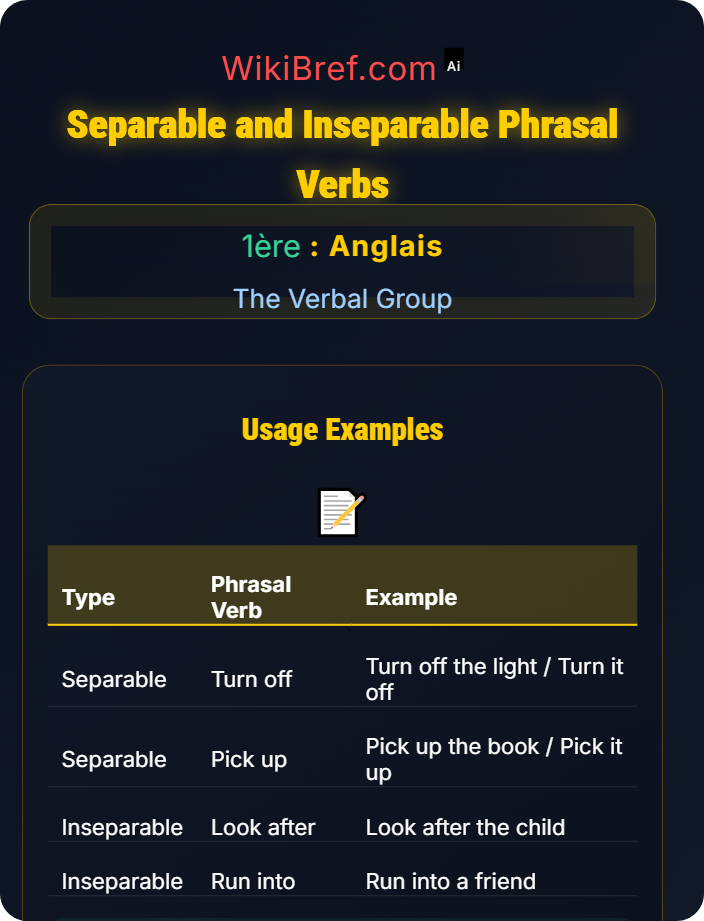
Turn off : Verbe composé séparable signifiant éteindre.
- Identifier le phrasal verb: turn off
- Reconnaître qu'il est séparable
- Noter la présence d'un objet nominal: the lights
- Choisir la structure: turn the lights off ou turn off the lights
"Turn off" est un verbe composé séparable, on peut insérer un objet entre "turn" et "off".
L'objet est "the lights" (nom). Pour les objets nominaux, deux positions sont possibles.
Structure correcte: turn off the lights ou turn the lights off
Please turn off the lights when you leave.
Please turn off the lights off when you leave.
• Séparable: Pour les objets nominaux, placement avant ou après la particule
• Séparable: Pour les objets pronoms, placement entre le verbe et la particule
• Exemples: Turn the lights off / Turn them off (correct), Turn off them (incorrect)
Take to school : Verbe composé inséparable signifiant accompagner à l'école.
"Take to school" est un verbe composé inséparable, l'objet ne peut pas être inséré.
L'objet est "your little brother" (nom). Pour les verbes inséparables, l'objet suit toujours la particule.
Structure correcte: take your little brother to school
Can you take your little brother to school?
Can you take your little brother to school?
• Inséparable: L'objet suit toujours la particule prépositionnelle
• Exemples: Look after him (correct), Look him after (incorrect)
• Prépositions: Souvent des prépositions qui exigent une position fixe
Throw away : Verbe composé séparable signifiant jeter.
"Throw away" est un verbe composé séparable, on peut insérer un objet.
L'objet est "this old newspaper" (nom long). Pour les objets nominaux longs, on place après la particule.
Structure correcte: throw away this old newspaper
Could you throw away this old newspaper?
Could you throw this old newspaper away?
• Séparable: Pour les objets nominaux longs, on place après la particule pour clarté
• Séparable: Pour les objets courts, les deux positions sont acceptables
• Clarté: "Throw away this old newspaper" est plus clair que "Throw this old newspaper away"
Look after : Verbe composé inséparable signifiant s'occuper de.
"Look after" est un verbe composé inséparable, l'objet ne peut pas être inséré.
L'objet est "her grandmother" (nom). Pour les verbes inséparables, l'objet suit toujours la particule.
Structure correcte: look after her grandmother
She looks after her grandmother every day.
She looks after her grandmother every day.
• Inséparable: L'objet suit toujours la particule prépositionnelle
• Prépositions: "After" est une préposition, donc inséparable
• Autres exemples: Look after him, Take care of her, Listen to them
Wrap up : Verbe composé séparable signifiant emballer.
"Wrap up" est un verbe composé séparable, on peut insérer un objet.
L'objet est "the presents" (nom). Pour les objets nominaux, deux positions sont possibles.
Structure correcte: wrap up the presents ou wrap the presents up
We need to wrap up the presents quickly.
We need to wrap the presents up quickly.
• Séparable: Pour les objets nominaux, placement avant ou après la particule
• Séparable: Pour les objets pronoms, placement entre le verbe et la particule
• Exemples: Wrap up the presents / Wrap them up (correct), Wrap up them (incorrect)