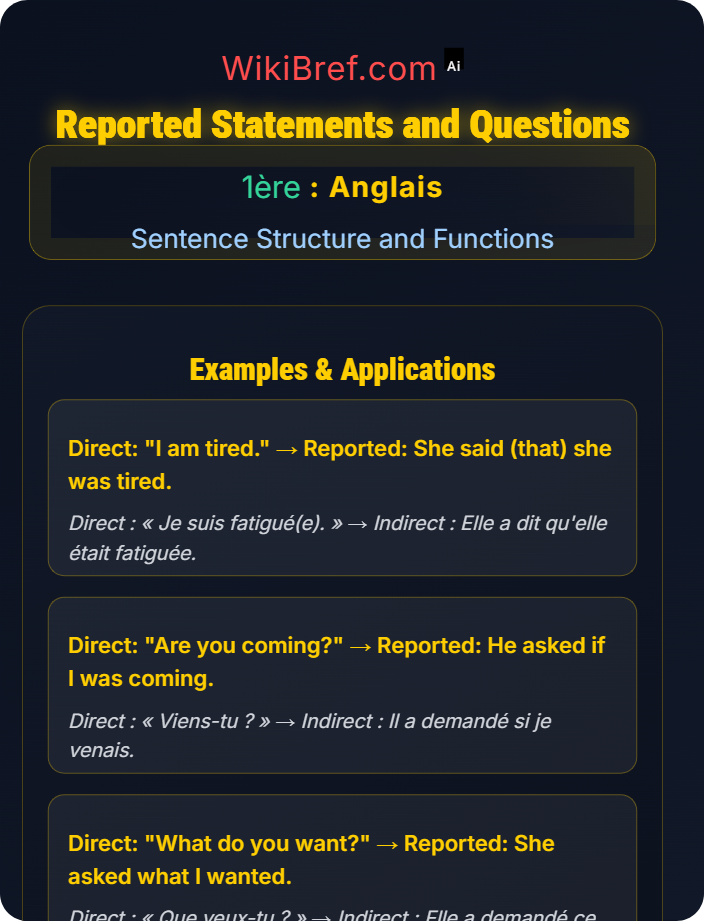
Reported statement : Transformation d'un énoncé direct en forme indirecte avec changement de temps et de pronom.
- Identifier le verbe introductif: "said" (passé)
- Changer le temps: "am" → "was" (backshift)
- Changer le pronom: "I" → "she"
- Supprimer les guillemets et ajouter "that"
"I am studying for my exams," said Sarah
Verbe introductif: "said" (passé simple)
Énoncé: "I am studying for my exams"
"am studying" (présent continu) → "was studying" (passé continu)
Car le verbe introductif est au passé
"I" → "she" (Sarah)
"my" → "her" (Sarah's exams)
Sarah said (that) she was studying for her exams
Le mot "that" est souvent omis dans le discours courant
Temps: Present → Past (am → was)
Pronoms: I → she, my → her
Sarah said (that) she was studying for her exams
Cette structure rapporte les paroles de Sarah de manière indirecte.
• Backshift : Present → Past when reporting verb is past
• Pronouns : Change according to speaker/listener roles
• Reporting verb : "Said" introduces reported statements
• That : Optional after "said" but often included for clarity
Reported yes/no question : Transformation d'une question directe en forme indirecte avec "if" ou "whether".
"Are you going to the party?" he asked me
Question oui/non: réponse possible "yes" ou "no"
Verbe introductif: "asked" (passé)
C'est une question fermée (yes/no)
Devient "if" ou "whether" dans le discours rapporté
"Are you going" → "if/whether I was going"
Le mot interrogatif "are" disparaît, devient "if"
"you" (interlocuteur) → "I" (je, le narrateur)
"are going" → "was going" (backshift)
He asked me if/whether I was going to the party
La structure devient: subject + verb + object + if/whether + statement
He asked me if/whether I was going to the party
Cette structure rapporte une question fermée de manière indirecte.
• Yes/No questions : Use "if" or "whether" in reported speech
• Transform to statement : Change question word order to statement order
• Backshift : Apply tense changes when reporting verb is past
• Pronouns : Adjust according to perspective in reported speech
Reported statement with present perfect : Transformation d'un énoncé avec le présent parfait en forme indirecte.
"I have finished my homework," replied Tom
Verbe introductif: "replied" (passé)
Énoncé: "I have finished my homework"
Temps: Present perfect
"have finished" (present perfect) → "had finished" (past perfect)
Car le verbe introductif est au passé
"I" → "he" (Tom)
"my" → "his" (Tom's homework)
Tom replied (that) he had finished his homework
Present perfect → Past perfect dans le discours rapporté
Le travail avait été terminé avant que Tom ne réponde
Cela justifie l'utilisation du past perfect
Tom replied (that) he had finished his homework
Cette structure rapporte une action achevée dans le passé.
• Present perfect → Past perfect : When reporting verb is past
• Logical sequence : Past perfect shows action completed before reported moment
• Consistency : All tenses shift back when main verb is in past
• That : Optional but can improve clarity
Reported wh-question : Transformation d'une question avec mot interrogatif en forme indirecte en gardant le mot.
"Where are you from?" the tourist asked
Question ouverte avec mot interrogatif: "where"
Verbe introductif: "asked" (passé)
C'est une question ouverte (wh-question)
Garde son mot interrogatif dans le discours rapporté
"Where are you from" → "where I was from"
Le mot interrogatif "where" est conservé
Le mot interrogatif "are" disparaît
"you" (interlocuteur) → "I" (le narrateur)
"are" → "was" (backshift)
The tourist asked where I was from
La structure devient: subject + verb + question word + statement
The tourist asked where I was from
Cette structure rapporte une question ouverte en conservant le mot interrogatif.
• Wh-questions : Keep the question word (where, when, why, how, etc.)
• Statement order : Change question word order to statement order
• Backshift : Apply tense changes when reporting verb is past
• No "if/whether" : Not used with wh-questions
Reported future question : Transformation d'une question sur le futur en forme indirecte avec changement de temps.
"Will you come to the meeting tomorrow?" she asked
Question sur une action future: "will you come"
Verbe introductif: "asked" (passé)
C'est une question ouverte avec "will"
Devient "if" ou "whether" dans le discours rapporté
"Will you come" → "if/whether I would come"
Future "will" → Conditional "would" (backshift)
"you" (interlocuteur) → "I" (le narrateur)
"tomorrow" → "the next day" (changement de déictique)
She asked if/whether I would come to the meeting the next day
Les adverbes de temps changent aussi dans le discours rapporté
She asked if/whether I would come to the meeting the next day
Cette structure rapporte une question sur une action future.
• Future → Conditional : Will → Would when reporting verb is past
• Time expressions : Change (now → then, today → that day, tomorrow → the next day)
• Yes/No question : Use "if/whether" for future questions
• Logical sequence : Maintain temporal relationships in reported speech
- Time: now → then, today → that day, tomorrow → the next day
- Place: here → there, this → that, these → those
- Pronouns: I → he/she, you → he/she/I/we, my → his/her/our
- Verb tenses: Backshift when main verb is past
• Yes/No: Use "if/whether", change to statement order
• Wh-questions: Keep question word, change to statement order
• Both: Apply backshift and pronoun changes
• Order: Question word order → Statement word order
- Universal truths: "The earth is round" → "He said the earth is round"
- Present reporting verb: "She says I am right" (no backshift)
- Still true: "I live in Paris" → "He says he lives in Paris" (still true)
- Modal verbs: Some contexts don't require backshift
- Le backshift est la règle générale mais pas absolue
- Les vérités universelles gardent leur temps
- Le verbe introductif au présent n'impose pas le backshift
- Le sens et le contexte déterminent parfois l'exception