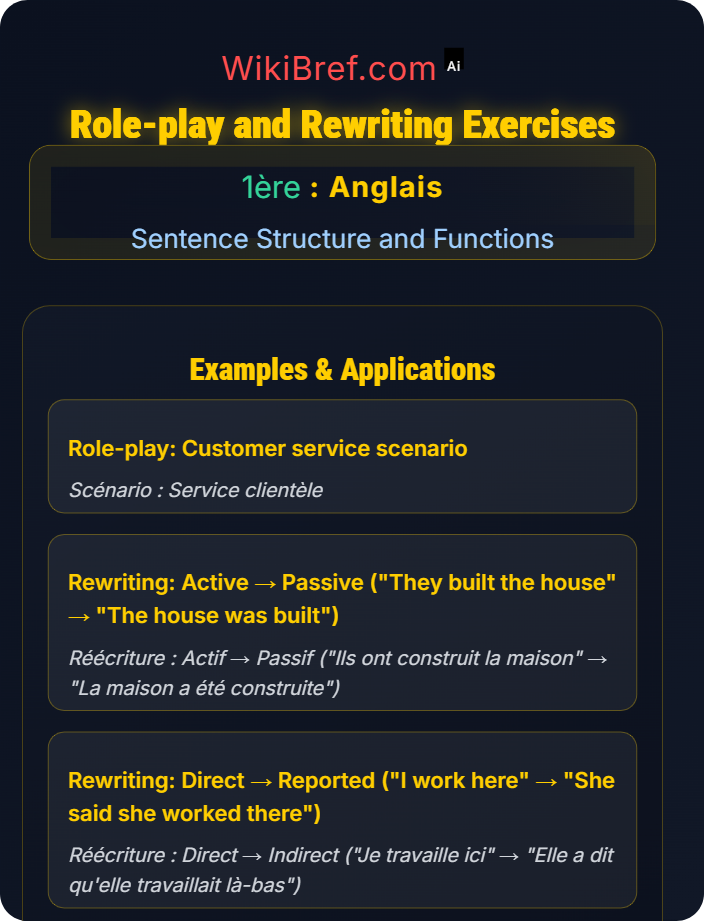
Reported statement : Transformation d'un énoncé direct en forme indirecte avec changement de temps et de pronom.
- Identifier le verbe introductif: "tells" (présent) ou "told" (passé)
- Changer le temps: "must" reste inchangé car vérité permanente
- Changer les pronoms: "you" → "they" (les élèves)
- Supprimer les guillemets et ajouter "that"
Teacher tells students: "You must complete the assignment by Friday"
Rôle: Enseignant s'adressant aux élèves
Verbe introductif: "tells" (présent, mais on suppose passé pour l'exercice)
Énoncé direct: "You must complete the assignment by Friday"
Type: Impératif/modale de nécessité
"You" (élèves) → "they" (les élèves)
"must" → reste inchangé (vérité permanente)
"complete" → "complete" (pas de backshift pour "must")
The teacher told the students (that) they must complete the assignment by Friday
Alternativement: The teacher told the students they had to complete...
Parfois "must" devient "had to" dans le discours rapporté
Cela dépend du contexte de l'obligation
The teacher told the students (that) they had to complete the assignment by Friday
Cette structure rapporte l'instruction donnée par l'enseignant.
• Modal verbs : "Must" → "Had to" in reported speech
• Pronoun changes : "You" → "They" for students
• Reporting verb : "Told" + indirect object + (that) + statement
• Time expressions : May need adjustment depending on context
Passive transformation : Changer une phrase active en phrase passive en mettant l'accent sur l'objet.
"The company hired new employees last month"
Sujet: The company, Verbe: hired, Objet: new employees
"new employees" est l'objet direct
Devient le sujet de la phrase passive
"hired" est au passé simple
La forme passive: was/were + past participle
"New employees" (pluriel) → "were hired"
Le sujet original peut devenir "by the company"
"New employees were hired by the company last month"
L'accent est maintenant mis sur les employés
New employees were hired by the company last month
Cette structure met l'accent sur les employés embauchés.
• Passive structure : Subject + be + past participle + (by + agent)
• Subject-verb agreement : "Employees" (plural) → "were"
• Tense consistency : Simple past → Simple past passive
• Focus shift : From doer to receiver of action
Reported question : Transformation d'une question directe en forme indirecte avec changement de structure.
Student asks teacher: "When will the exam results be announced?"
Rôle: Élève posant une question à l'enseignant
Verbe introductif: "asks" (présent) ou "asked" (passé)
"When will the exam results be announced?"
C'est une question wh-question (ouverte) avec mot interrogatif
Question word: "When" est conservé
Question word order → Statement word order
"will be announced" → "would be announced" (backshift)
Direct: "When will the exam results be announced?"
Indirect: "when the exam results would be announced"
The student asked the teacher when the exam results would be announced
Le mot interrogatif est conservé, mais l'ordre change
The student asked the teacher when the exam results would be announced
Cette structure rapporte la question de l'élève de manière indirecte.
• Wh-questions : Keep question word, change to statement order
• Future → Conditional : Will → Would in reported speech
• Passive preserved : "Be announced" remains in passive form
• Reporting verb : "Asked" + indirect object + question word + statement
Active transformation : Changer une phrase passive en phrase active en identifiant l'agent.
"The new policy was implemented by the management team"
Sujet: The new policy, Verbe: was implemented, Agent: by the management team
"by the management team" est l'agent
Devient le sujet de la phrase active
Nouveau sujet: "the management team"
Nouvel objet: "the new policy"
"was implemented" (passive, past) → "implemented" (active, past)
Retirer "was/were" + "by" + agent
"The management team implemented the new policy"
L'accent est maintenant mis sur l'acteur
The management team implemented the new policy
Cette structure met l'accent sur l'équipe de direction.
• Active structure : Subject + verb + object
• Agent identification : "By" phrase becomes subject
• Verb transformation : Remove "be" + "by" + return to base form
• Focus restoration : Return emphasis to the doer of the action
Reported imperative : Transformation d'un impératif direct en forme indirecte avec "tell/ask + object + to + infinitive".
Manager says to employee: "You should submit your report immediately"
Rôle: Manager donnant une instruction à un employé
Verbe introductif: "says" (présent) ou "said" (passé)
Énoncé: "You should submit your report immediately"
Type: Conseil/modale de recommandation
"Should" est une modal de recommandation
Dans le discours rapporté: "should" → "should" (reste souvent inchangé)
"You" (employee) → "he/she" (l'employé)
"should" → reste "should" (recommandation persistante)
"submit" → reste "submit" (infinitive)
The manager told the employee (that) he/she should submit his/her report immediately
Alternativement: The manager advised the employee to submit the report immediately
The manager told the employee (that) he should submit his report immediately
OU: The manager advised the employee to submit the report immediately
Cette structure rapporte la recommandation du manager.
• Advice reporting : "Told" + object + (that) + should + infinitive
• Alternative : "Advised" + object + to + infinitive
• Modal preservation : "Should" often remains unchanged in reported speech
• Pronoun adaptation : "You" → "he/she" based on role context
- Identification : Reconnaitre la structure à transformer
- Analyse : Comprendre les composants de la phrase
- Application : Appliquer les règles grammaticales appropriées
- Vérification : S'assurer que le sens est préservé
• Pronom personnel : S'adapter au point de vue du personnage
• Temps verbaux : Appliquer le backshift selon le contexte
• Accord sujet-verbe : Maintenir la cohérence grammaticale
• Temps adverbiaux : Ajuster "now" → "then", "today" → "that day"
- Incorrect backshift : "He said he lives here" → Should be "lived" if past context
- Missing pronoun changes : "He told me you are late" → Should be "I was late"
- Wrong question word order : "He asked what did you do" → Should be "what you did"
- Improper passive formation : "The book was wrote" → Should be "was written"
- La réécriture conserve toujours le sens original
- Les transformations doivent respecter la grammaire anglaise
- Le contexte de rôle influence les choix grammaticaux
- La pratique régulière améliore la fluidité des transformations