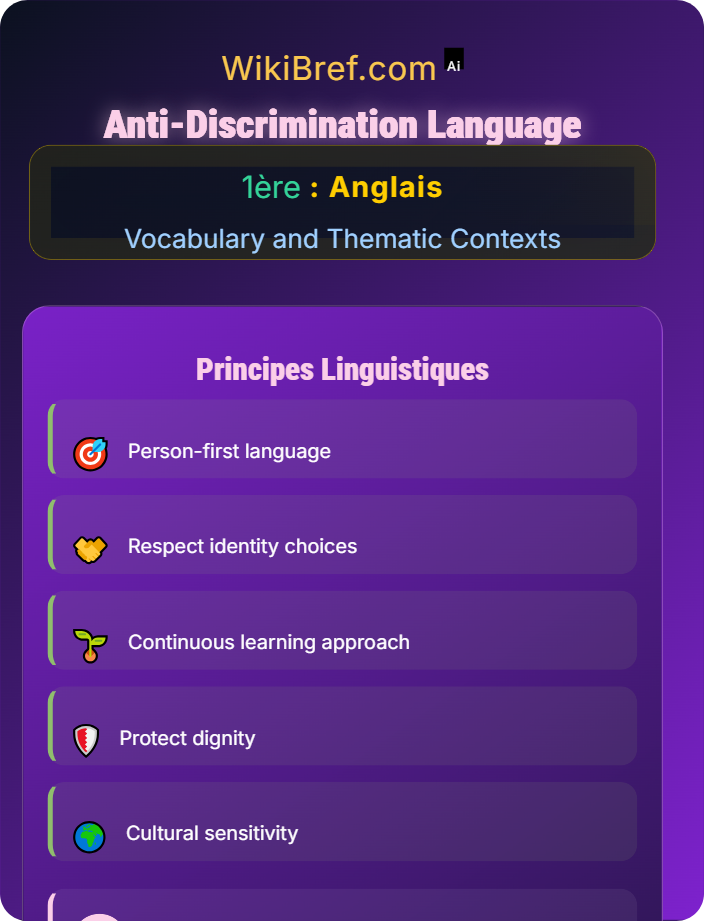
Langage descriptif des personnes : Approche linguistique qui met l'accent sur l'individu avant sa condition, soulignant la dignité humaine plutôt que les limitations perçues.
- Identification : Repérer les termes potentiellement discriminatoires
- Remplacement : Utiliser des expressions centrées sur la personne
- Confirmation : Vérifier que le langage respecte les préférences individuelles
- Éducation : Sensibiliser à l'impact des mots choisis
"Instead of using terms like 'handicapped,' 'crippled,' or 'confined to a wheelchair,' use 'person with a disability,' 'person who uses a wheelchair,' or 'wheelchair user.' These alternatives emphasize the person rather than the condition."
"Use specific, accurate descriptions such as 'person with visual impairment' instead of 'blind person,' or 'individual with mobility limitations' instead of 'wheelchair-bound.' This respects the person's full identity."
"Focus on abilities rather than limitations. Say 'person who uses assistive technology' instead of 'person unable to see,' or 'individual with adaptive communication methods' instead of 'person who cannot speak clearly.'"
"Some individuals prefer identity-first language (e.g., 'autistic person') while others prefer person-first language (e.g., 'person with autism'). When possible, ask individuals their preference and respect their choice."
"Ensure that language choices support accessibility by being clear, concise, and inclusive. Use plain language that everyone can understand, avoiding jargon or complex terms that might exclude some individuals."
"Stay informed about evolving terminology and best practices. Language preferences and understanding of disabilities continue to evolve, requiring ongoing learning and adaptation in communication approaches."
Le langage inclusif pour les personnes handicapées met l'accent sur la dignité humaine en utilisant un langage descriptif des personnes, en évitant les termes péjoratifs, en respectant les préférences individuelles et en soulignant les capacités plutôt que les limitations.
• Person-First : Mettre la personne avant la condition
• Respect : Reconnaître les préférences individuelles
• Précision : Utiliser des descriptions précises
• Capacités : Mettre en avant les forces et aptitudes
Langage neutre : Utilisation de termes et de structures grammaticales qui ne supposent pas de genre binaire, permettant à toutes les identités de genre de se sentir incluses et respectées.
"Use 'they/them' pronouns when gender is unknown or irrelevant. For example, 'Each student should bring their textbooks' instead of 'his or her textbooks.' This eliminates gender assumptions and supports gender-neutral language."
"Replace gendered job titles with neutral alternatives: 'chairperson' instead of 'chairman,' 'police officer' instead of 'policeman,' 'flight attendant' instead of 'stewardess,' and 'firefighter' instead of 'fireman.'"
"Use inclusive greetings like 'Dear colleague' or 'Hello everyone' instead of 'Dear Sir/Madam' or 'Ladies and Gentlemen.' Ask individuals about their preferred pronouns and use them consistently."
"Acknowledge diverse gender identities including transgender, non-binary, and genderqueer individuals. Use 'Ms.' as a gender-neutral title unless someone specifies their preferred title."
"Include gender-neutral options on forms and documents. Provide 'Other' or 'Self-describe' options alongside 'Male' and 'Female,' and consider adding a separate field for pronouns to normalize inclusive practices."
"If you make a mistake about someone's pronouns, apologize briefly and continue using their correct pronouns. Avoid making excuses or drawing excessive attention to the error, which can cause further discomfort."
"Stay informed about evolving language around gender identity. Terms and understanding continue to develop, requiring ongoing education and sensitivity to ensure inclusive communication practices."
Le langage neutre et le respect des identités de genre impliquent l'utilisation de pronoms neutres, de termes professionnels non genrés, de salutations inclusives, la reconnaissance des identités diverses, et une éducation continue sur les évolutions linguistiques.
• Neutralité : Éviter les suppositions de genre
• Respect : Utiliser les pronoms préférés
• Inclusivité : Accueillir toutes les identités
• Éducation : Apprendre continuellement sur les évolutions
Sensibilité culturelle : Conscience et respect des différences culturelles, ethniques et raciales, exprimés à travers un langage qui évite les stéréotypes et les généralisations.
"Use terminology that ethnic groups prefer for themselves. For example, use 'African American' or 'Black' as preferred, 'Native American' or 'American Indian' (depending on preference), 'Hispanic' or 'Latino/Latina/Latinx' based on individual preference."
"Avoid language that perpetuates stereotypes about ethnic or cultural groups. Instead of saying 'Asian students are naturally good at math,' acknowledge individual differences and avoid generalizations about abilities or characteristics."
"Use specific and accurate descriptors. Say 'person of color' instead of 'colored person,' 'refugee' instead of 'illegal immigrant,' and 'individual from the Middle East' instead of assuming religious affiliation."
"Acknowledge multiracial and multicultural identities. Use terms like 'multiracial' or 'biracial' when appropriate, and avoid forcing individuals into single category assumptions based on appearance."
"Be aware of the historical context of certain terms. Some words carry painful historical associations and should be avoided. Understand the evolution of terminology and why certain terms have been replaced."
"Promote inclusive language in educational and professional settings by updating policies, training materials, and official communications to reflect culturally sensitive terminology and practices."
"Continuously educate yourself about cultural diversity and the impact of language. Engage in cultural competency training and stay informed about evolving terminology and best practices for inclusive communication."
Le langage culturellement sensible et respectueux de la diversité ethnique implique l'utilisation des termes préférés par les groupes, l'évitement des stéréotypes, la précision descriptives, la reconnaissance des origines multiples, la conscience historique et l'éducation continue.
• Préférence : Utiliser les termes choisis par les groupes
• Précision : Éviter les généralisations
• Histoire : Comprendre le contexte des termes
• Respect : Reconnaître la diversité des origines
Discrimination sexuelle : Traitement inégal basé sur le sexe ou le genre, incluant le harcèlement sexuel, les stéréotypes de genre et les inégalités dans les opportunités professionnelles et éducatives.
"Use gender-neutral language to avoid reinforcing traditional gender roles. Say 'police officer' instead of 'policeman,' 'nurse' for both male and female caregivers, and 'firefighter' regardless of gender. This prevents assumptions about job suitability based on sex."
"Challenge language that perpetuates gender stereotypes. Instead of saying 'boys don't cry' or 'girls should be gentle,' acknowledge that emotions and behaviors are not determined by gender. Avoid phrases like 'man up' or 'throw like a girl.'"
"Recognize and address sexual harassment language, including inappropriate jokes, comments about appearance, or unwanted advances. Create environments where such behavior is not tolerated and where reporting mechanisms are clear and safe."
"Promote language that supports equal opportunities regardless of gender. Encourage phrases like 'any qualified candidate' instead of 'strong male candidate' and support women in STEM fields with inclusive language and encouragement."
"Address pay gap language by advocating for equal compensation discussions. Use terms that emphasize merit and qualifications over gender when discussing salaries and promotions. Challenge the 'pink tax' concept in pricing discussions."
"Use empowering language that supports women in leadership roles. Refer to female leaders as 'executives,' 'directors,' or 'CEOs' without qualifying terms like 'female CEO.' Celebrate achievements without gender-specific descriptors."
"Implement gender sensitivity training and create policies that address discriminatory language. Establish clear guidelines for inclusive communication and provide resources for understanding the impact of gender-biased language."
L'égalité de genre et la lutte contre la discrimination sexuelle nécessitent un langage égalitaire, l'évitement des stéréotypes, la reconnaissance du harcèlement, le soutien des opportunités égales, l'équité salariale, le soutien au leadership féminin et l'éducation continue.
• Égalité : Traitement équitable sans distinction de sexe
• Stéréotypes : Évitement des généralisations de genre
• Respect : Reconnaissance de la dignité de tous
• Opportunités : Accès égal aux chances et responsabilités
Milieu inclusif : Environnement éducatif ou professionnel qui promeut l'égalité, le respect et l'acceptation de la diversité, en utilisant un langage qui ne discrimine personne.
"Establish clear language policies that prohibit discriminatory terms and promote inclusive communication. Include these guidelines in student handbooks, employee manuals, and institutional communications to set expectations for respectful interaction."
"Provide regular training for teachers, administrators, managers, and employees on inclusive language practices. Include scenarios, best practices, and the impact of discriminatory language on individuals and communities."
"Create systems for monitoring language use and addressing discriminatory communication. Implement anonymous reporting mechanisms and establish clear consequences for repeated violations of inclusive language policies."
"Foster environments where individuals feel safe to express concerns about discriminatory language. Create support networks and resources for those who experience or witness discrimination, ensuring they have avenues for help and resolution."
"Ensure that curriculum materials, presentations, and educational resources use inclusive language. Review textbooks, assignments, and multimedia content for discriminatory language and update them to reflect diverse perspectives and experiences."
"Apply inclusive language standards to all external communications, including websites, promotional materials, job postings, and public statements. This demonstrates institutional commitment to diversity and inclusion to the broader community."
"Regularly assess the effectiveness of anti-discrimination language initiatives through surveys, focus groups, and outcome data. Adjust policies and practices based on feedback and emerging best practices for inclusive communication."
Le langage anti-discriminatoire dans les milieux scolaires et professionnels nécessite des politiques claires, une formation continue, une surveillance active, un environnement de soutien, des contenus inclusifs, une communication externe responsable et une évaluation continue des progrès.
• Politiques : Encadrement clair des attentes
• Formation : Éducation continue du personnel
• Surveillance : Systèmes de suivi et correction
• Évaluation : Mesure continue de l'efficacité