Placement de la négation
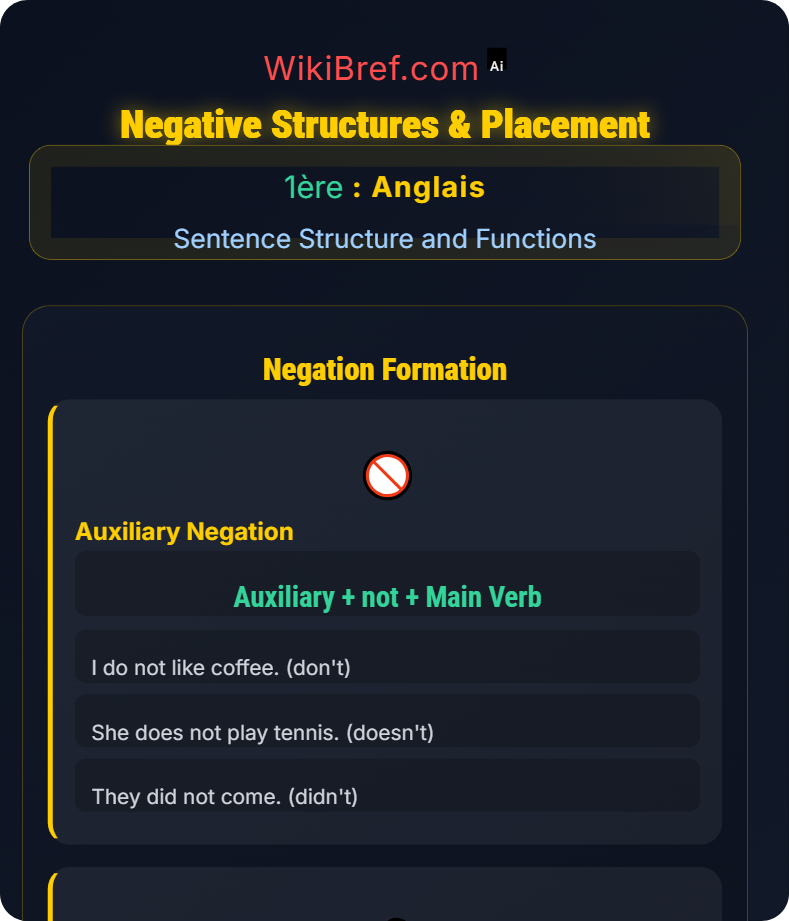
Subject + Auxiliary + not + Verb
Subject
Auxiliary
not
Verb
After auxiliaries
Before main verb
Between subject and verb
With contractions possible
Exemples de placement:
I don't like coffee.
She doesn't work here.
They haven't finished yet.
She doesn't work here.
They haven't finished yet.
Types de structures négatives
Do/Does/Did + not
Be verbs + not
Modal verbs + not
Auxiliaries + not
Contractions (don't, isn't, won't)
Exemples détaillés
Do/Does/Did:
I don't understand.
She doesn't speak French.
We didn't go to school.
She doesn't speak French.
We didn't go to school.
Be verbs:
I am not ready.
She isn't here.
They weren't happy.
She isn't here.
They weren't happy.
Modaux:
I cannot swim.
She shouldn't leave.
They won't come.
She shouldn't leave.
They won't come.
Cas particuliers
Without auxiliaries:
I never eat meat.
She hardly ever works late.
They barely know each other.
She hardly ever works late.
They barely know each other.
Double negatives:
I don't know nothing. (incorrect)
I don't know anything. (correct)
Nobody saw nothing. (incorrect)
I don't know anything. (correct)
Nobody saw nothing. (incorrect)
Negation in questions:
Don't you like pizza?
Haven't they arrived yet?
Isn't she coming?
Haven't they arrived yet?
Isn't she coming?
Erreurs fréquentes
Erreur 1:
Placer "not" après le verbe principal
Erreur 2:
Double négation en anglais standard
Erreur 3:
Oublier l'auxiliaire dans les questions négatives
Conseils de mémorisation
Auxiliaire + not + verbe
Contractions: don't, isn't, hasn't
Pratiquer avec des affirmations opposées