Définition des Question Tags
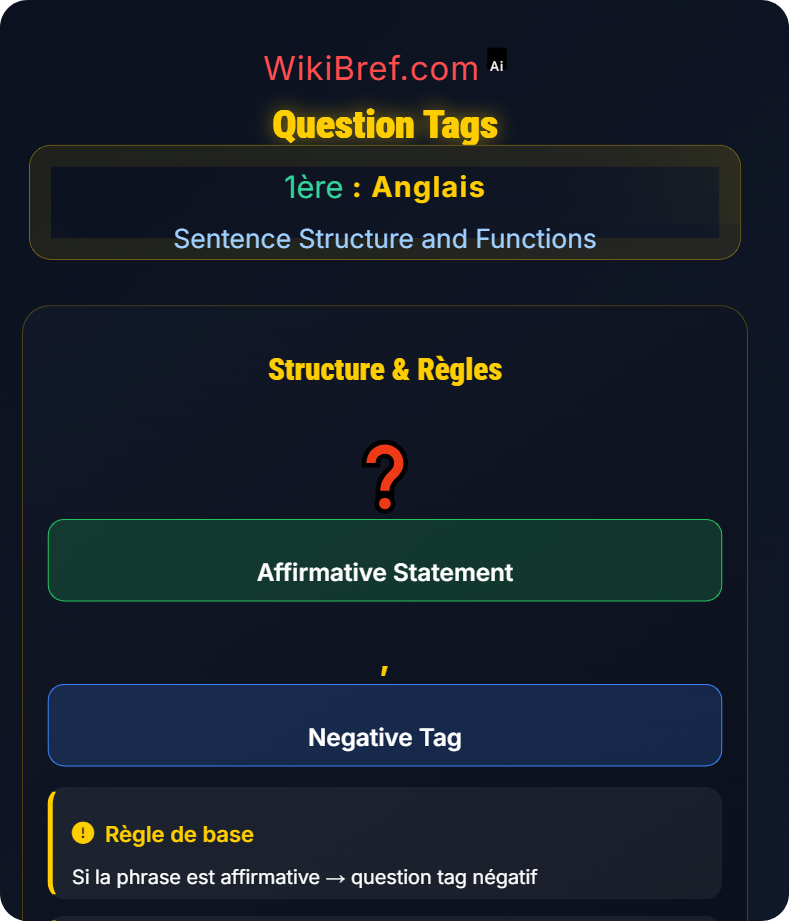
Question Tag = Affirmation + ?, + Tag négatif/affirmatif
Ex: You are happy, aren't you?
Définition: Petits ajouts à la fin d'une phrase pour demander confirmation
Fonction: Vérifier une supposition ou obtenir une réponse
Structure: Sujet + Verbe + (n') + Tag (Verbe auxiliaire + Pronom)
Exemples de base :
He is here, isn't he?
She doesn't like coffee, does she?
They were late, weren't they?
She doesn't like coffee, does she?
They were late, weren't they?
Règles Fondamentales
Règle 1: Tag opposé à la phrase principale
Règle 2: Utiliser le même verbe auxiliaire
Règle 3: Accord du pronom personnel
Règle 4: Intonation montante = demande réelle
Règle 5: Intonation descendante = confirmation
Cas Particuliers
I am → aren't I?
Let's → shall we?
Nobody, nothing → do they?
Méthodes & Astuces
Méthode: Trouver le verbe principal dans la phrase
Astuce: Positif → Négatif tag, Négatif → Positif tag
Mémorisation: Remplacer sujet par pronom personnel
Pratique: Répéter à haute voix pour l'intonation
Erreur commune: Ne pas inverser le sens du tag
Exemples Détaillés
Affirmatif → Négatif :
You can swim, can't you?
We have finished, haven't we?
It rains often, doesn't it?
We have finished, haven't we?
It rains often, doesn't it?
Négatif → Affirmatif :
You don't smoke, do you?
She hasn't eaten, has she?
They won't come, will they?
She hasn't eaten, has she?
They won't come, will they?