Définitions et Concepts
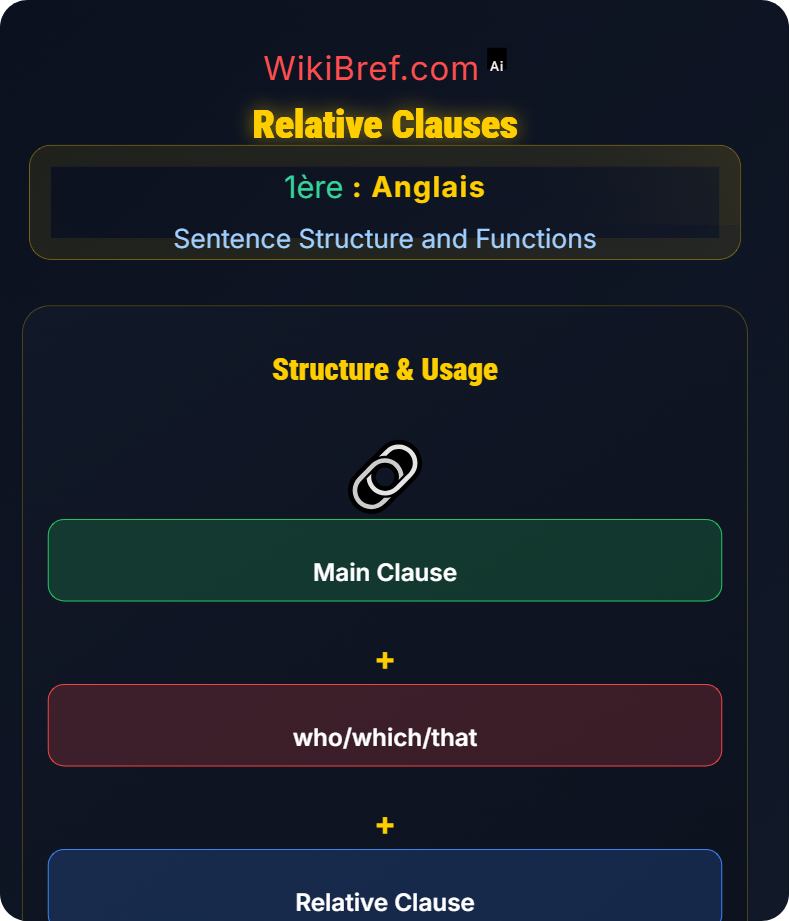
Relative Clause = Mot relatif + Sujet + Verbe
Ex: The girl who is reading → "who is reading" = relative clause
Définition: Phrase qui modifie un nom
Fonction: Donner plus d'informations
Structure: Nom + Mot relatif + Information
Exemple de base :
The book which I bought is interesting.
The man who called me was my boss.
The car that broke down was old.
The man who called me was my boss.
The car that broke down was old.
Règles d'Utilisation
Who: Personnes (sujet ou objet)
Which: Choses (sujet ou objet)
That: Personnes ou choses (définissant)
Restrictive: Essentiel → Pas de virgule
Non-restrictive: Supplémentaire → Virgule
Formules et Cas Spéciaux
Who/Whom: Who = sujet, Whom = objet
Where: Lieux (in which, at which)
When: Temps (at which, on which)
Exemples et Méthodes
WHO (personnes) :
The woman who works here is kind.
The student who answered got it right.
The person whom I met was friendly.
The student who answered got it right.
The person whom I met was friendly.
WHICH (choses) :
The book which I read was fascinating.
The house which is red belongs to them.
The car which broke down needed repair.
The house which is red belongs to them.
The car which broke down needed repair.
THAT (personnes/choses) :
The film that we saw was excellent.
The people that helped us were generous.
The idea that you suggested is brilliant.
The people that helped us were generous.
The idea that you suggested is brilliant.
Astuces & Méthodes
Méthode: Identifier le nom à modifier
Astuce: Who = personne, Which = chose
Mémorisation: That remplace who/which dans phrases restrictives
Pratique: Combiner deux phrases avec relative clause
Erreur commune: Omettre le mot relatif quand nécessaire