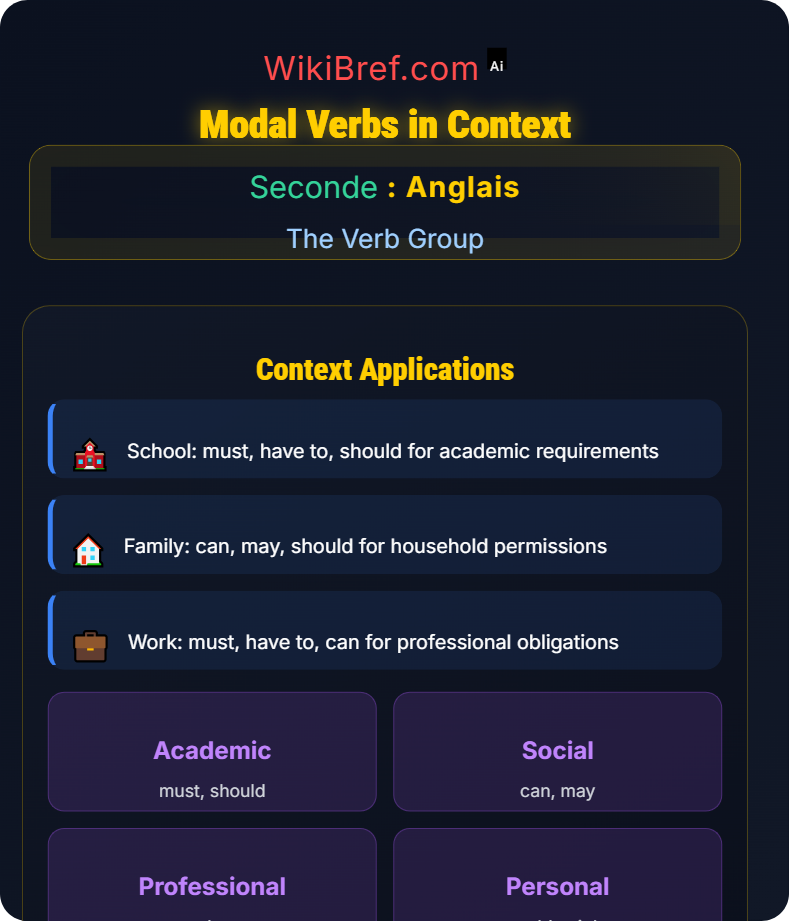
Les verbes modaux principaux
CAN, COULD, MAY, MIGHT, MUST, SHOULD, WILL, WOULD, SHALL
Forme : Sujet + Modal + Verbe à l'infinitif (sans TO)
| Modal | Fonction | Exemple |
|---|---|---|
| CAN | Capacité | I can swim. |
| MAY | Permission | You may leave now. |
| MUST | Obligation | You must study hard. |
| SHOULD | Conseil | You should eat vegetables. |
Structure générale :
Sujet + Modal + Verbe à l'infinitif (sans TO)
Ex: She can speak French.
Négatif: Sujet + Modal + NOT + Verbe
Interrogatif: Modal + Sujet + Verbe?
Ex: She can speak French.
Négatif: Sujet + Modal + NOT + Verbe
Interrogatif: Modal + Sujet + Verbe?
Fonctions des verbes modaux
CAN: Capacité, possibilité
MAY: Permission formelle
MUST: Obligation forte
SHOULD: Conseil ou suggestion
WILL: Futur intentionnel
WOULD: Conditionnel passé
Formes négatives et interrogatives
Négatif: Modal + NOT
Interrogatif: Modal + Sujet?
Pas de "DO/DOES" avec modaux
Conseils & Astuces
Jamais "TO" après les modaux
COULD = forme polie de CAN
MAY/MIGHT pour probabilité
MUSTN'T = interdiction
SHOULD = conseil, pas obligation
WOULD = WILL + politesse
Exemples détaillés
CAN:
Affirmatif: I can drive.
Négatif: I cannot/can't drive.
Question: Can you drive?
Négatif: I cannot/can't drive.
Question: Can you drive?
MUST:
Affirmatif: You must arrive on time.
Négatif: You mustn't smoke here.
Question: Must I wear a uniform?
Négatif: You mustn't smoke here.
Question: Must I wear a uniform?
SHOULD:
Affirmatif: You should exercise daily.
Négatif: You shouldn't eat too much.
Question: Should I call him?
Négatif: You shouldn't eat too much.
Question: Should I call him?