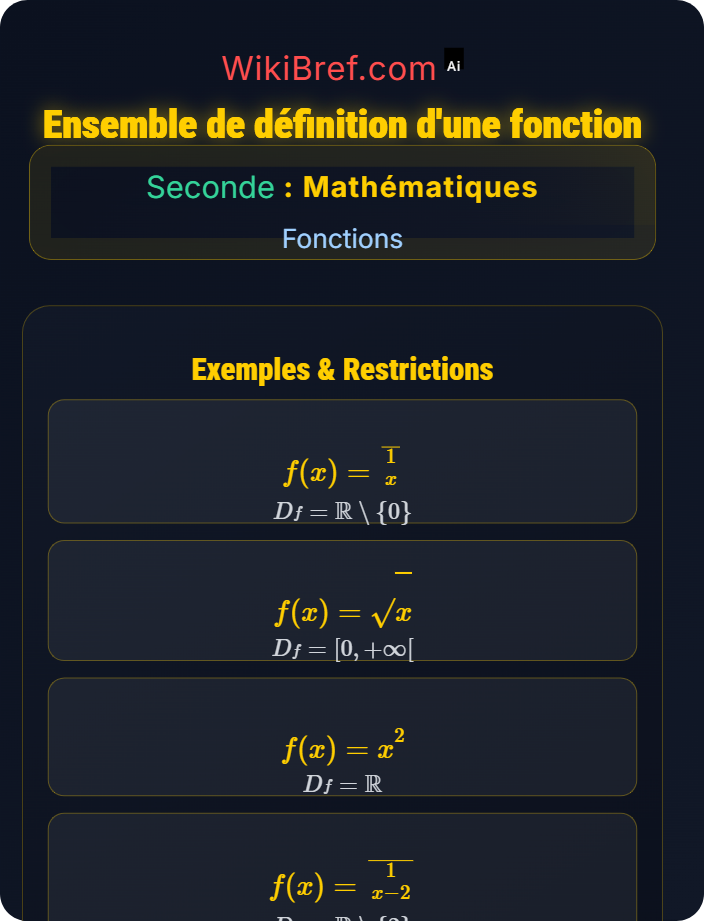
Ensemble de définition : Ensemble des valeurs de x pour lesquelles f(x) existe.
- Identifier les opérations pouvant poser problème
- Rechercher les valeurs interdites
- Conclure sur l'ensemble de définition
f(x) = 2x + 3
Opérations présentes : multiplication et addition
• Multiplication : 2x est défini pour tout x réel
• Addition : 2x + 3 est défini pour tout x réel
• Pas de division, racine carrée, ni logarithme
Il n'y a aucune restriction, donc f(x) existe pour tout x réel
\(\mathcal{D}_f = \mathbb{R}\)
• Fonction affine : f(x) = ax + b est définie sur ℝ
• Absence de restrictions : Pas de division, racine, log
• Linéarité : Toutes les opérations sont autorisées
Division : Le dénominateur ne doit jamais être nul.
g(x) = 1/(x-2)
Restriction : x - 2 ≠ 0
x - 2 ≠ 0
x ≠ 2
Tous les réels sauf 2
\(\mathcal{D}_g = \mathbb{R} \setminus \{2\} = ]-\infty; 2[ \cup ]2; +\infty[\)
Pour x = 2 : g(2) = 1/(2-2) = 1/0 → impossible
Pour x ≠ 2 : g(x) est bien défini
\(\mathcal{D}_g = \mathbb{R} \setminus \{2\}\) ou \(\mathcal{D}_g = ]-\infty; 2[ \cup ]2; +\infty[\)
• Division : Dénominateur ≠ 0
• Ensemble privé : ℝ privé de la valeur interdite
• Intervalle : Union de deux intervalles ouverts
Racine carrée : Le radicande doit être ≥ 0.
h(x) = √(x+5)
Restriction : x + 5 ≥ 0
x + 5 ≥ 0
x ≥ -5
Tous les réels supérieurs ou égaux à -5
\(\mathcal{D}_h = [-5; +\infty[\)
Pour x = -5 : h(-5) = √(-5+5) = √0 = 0 → OK
Pour x = -6 : h(-6) = √(-6+5) = √(-1) → impossible
Pour x = 0 : h(0) = √(0+5) = √5 → OK
\(\mathcal{D}_h = [-5; +\infty[\)
• Racine carrée : √X existe ssi X ≥ 0
• Inéquation : Résoudre X ≥ 0
• Intervalle : Semi-droite fermée à gauche
Division : Dénominateur ≠ 0, ici x² - 4 ≠ 0.
f(x) = 1/(x²-4)
Restriction : x² - 4 ≠ 0
x² - 4 = (x-2)(x+2)
Donc (x-2)(x+2) ≠ 0
Produit nul ssi l'un des facteurs est nul
Donc x - 2 ≠ 0 et x + 2 ≠ 0
Donc x ≠ 2 et x ≠ -2
Tous les réels sauf -2 et 2
\(\mathcal{D}_f = \mathbb{R} \setminus \{-2, 2\}\)
\(\mathcal{D}_f = ]-\infty; -2[ \cup ]-2; 2[ \cup ]2; +\infty[\)
\(\mathcal{D}_f = \mathbb{R} \setminus \{-2, 2\}\) ou \(\mathcal{D}_f = ]-\infty; -2[ \cup ]-2; 2[ \cup ]2; +\infty[\)
• Identité remarquable : a² - b² = (a-b)(a+b)
• Produit nul : (x-a)(x-b) = 0 ssi x = a ou x = b
• Union d'intervalles : Trois parties disjointes
Racine carrée : Le radicande 4-x² ≥ 0.
g(x) = √(4-x²)
Restriction : 4 - x² ≥ 0
4 - x² ≥ 0
4 ≥ x²
x² ≤ 4
-2 ≤ x ≤ 2
4 - x² = (2-x)(2+x)
(2-x)(2+x) ≥ 0
Tableau de signes : x ∈ [-2, 2]
Tous les réels entre -2 et 2 inclus
\(\mathcal{D}_g = [-2; 2]\)
Pour x = -2 : g(-2) = √(4-4) = √0 = 0 → OK
Pour x = 0 : g(0) = √(4-0) = √4 = 2 → OK
Pour x = 2 : g(2) = √(4-4) = √0 = 0 → OK
Pour x = 3 : g(3) = √(4-9) = √(-5) → impossible
\(\mathcal{D}_g = [-2; 2]\)
• Racine carrée : √X existe ssi X ≥ 0
• Inéquation quadratique : x² ≤ a² ssi -a ≤ x ≤ a
• Identité remarquable : a² - b² = (a-b)(a+b)
Fraction avec racine : Deux conditions simultanées.
h(x) = √(x-1)/(x+3)
Restrictions :
• x - 1 ≥ 0 (racine)
• x + 3 ≠ 0 (division)
x - 1 ≥ 0
x ≥ 1
x + 3 ≠ 0
x ≠ -3
x ≥ 1 ET x ≠ -3
Comme 1 > -3, la condition x ≠ -3 est automatiquement vérifiée
Donc x ≥ 1
\(\mathcal{D}_h = [1; +\infty[\)
\(\mathcal{D}_h = [1; +\infty[\)
• Système de conditions : Toutes les conditions doivent être vérifiées
• Intersection : Solutions communes aux deux conditions
• Prévalence : Si une condition implique une autre, on ne retient que la plus restrictive
Fraction rationnelle : Dénominateur ≠ 0.
f(x) = (x+1)/(x²+x-2)
Restriction : x² + x - 2 ≠ 0
a = 1, b = 1, c = -2
Δ = b² - 4ac = 1² - 4(1)(-2) = 1 + 8 = 9
√Δ = 3
x₁ = (-b - √Δ)/(2a) = (-1 - 3)/2 = -4/2 = -2
x₂ = (-b + √Δ)/(2a) = (-1 + 3)/2 = 2/2 = 1
x² + x - 2 = (x + 2)(x - 1)
Donc x² + x - 2 = 0 ssi x = -2 ou x = 1
\(\mathcal{D}_f = \mathbb{R} \setminus \{-2, 1\}\)
\(\mathcal{D}_f = ]-\infty; -2[ \cup ]-2; 1[ \cup ]1; +\infty[\)
\(\mathcal{D}_f = \mathbb{R} \setminus \{-2, 1\}\)
• Équation du second degré : ax² + bx + c = 0
• Discriminant : Δ = b² - 4ac
• Racines : x = (-b ± √Δ)/(2a)
Racine carrée : x² - 9 ≥ 0.
g(x) = √(x²-9)
Restriction : x² - 9 ≥ 0
x² - 9 = (x-3)(x+3)
Donc (x-3)(x+3) ≥ 0
• x - 3 = 0 ssi x = 3
• x + 3 = 0 ssi x = -3
• Tableau : (x-3)(x+3) ≥ 0 pour x ∈ ]-∞, -3] ∪ [3, +∞[
x² - 9 ≥ 0
x² ≥ 9
|x| ≥ 3
x ≥ 3 ou x ≤ -3
\(\mathcal{D}_g = ]-\infty; -3] \cup [3; +\infty[\)
\(\mathcal{D}_g = ]-\infty; -3] \cup [3; +\infty[\)
• Identité remarquable : a² - b² = (a-b)(a+b)
• Produit de facteurs : Signe dépend du nombre de facteurs négatifs
• Valeur absolue : x² ≥ a² équivaut à |x| ≥ a
Division par racine : Deux conditions strictes.
h(x) = 1/√(x+2)
Restrictions :
• x + 2 ≥ 0 (racine)
• √(x+2) ≠ 0 (division)
x + 2 ≥ 0
x ≥ -2
√(x+2) ≠ 0
x + 2 ≠ 0
x ≠ -2
x ≥ -2 ET x ≠ -2
Donc x > -2
\(\mathcal{D}_h = ]-2; +\infty[\)
Pour x = -2 : √(x+2) = √0 = 0, donc division par 0 → impossible
Pour x = -1 : √(-1+2) = √1 = 1, donc 1/1 = 1 → OK
\(\mathcal{D}_h = ]-2; +\infty[\)
• Racine stricte : Pour division, √X > 0 (donc X > 0)
• Double condition : X ≥ 0 ET X ≠ 0 équivaut à X > 0
• Intervalles ouverts : Parenthèses pour exclusion de valeurs
Somme de deux expressions : Chaque terme doit exister.
f(x) = √(x-1) + 1/(x-3)
Restrictions :
• x - 1 ≥ 0 (racine)
• x - 3 ≠ 0 (division)
x - 1 ≥ 0
x ≥ 1
x - 3 ≠ 0
x ≠ 3
x ≥ 1 ET x ≠ 3
Donc x ∈ [1, 3[ ∪ ]3, +∞[
Pour x = 1 : √(1-1) + 1/(1-3) = √0 + 1/(-2) = 0 - 0.5 = -0.5 → OK
Pour x = 3 : √(3-1) + 1/(3-3) = √2 + 1/0 → impossible
Pour x = 4 : √(4-1) + 1/(4-3) = √3 + 1/1 = √3 + 1 → OK
\(\mathcal{D}_f = [1; 3[ \cup ]3; +\infty[\)
• Somme de fonctions : f + g définie là où f et g sont toutes deux définies
• Intersection d'ensembles : Conditions simultanées
• Union d'intervalles : Plusieurs parties disjointes